
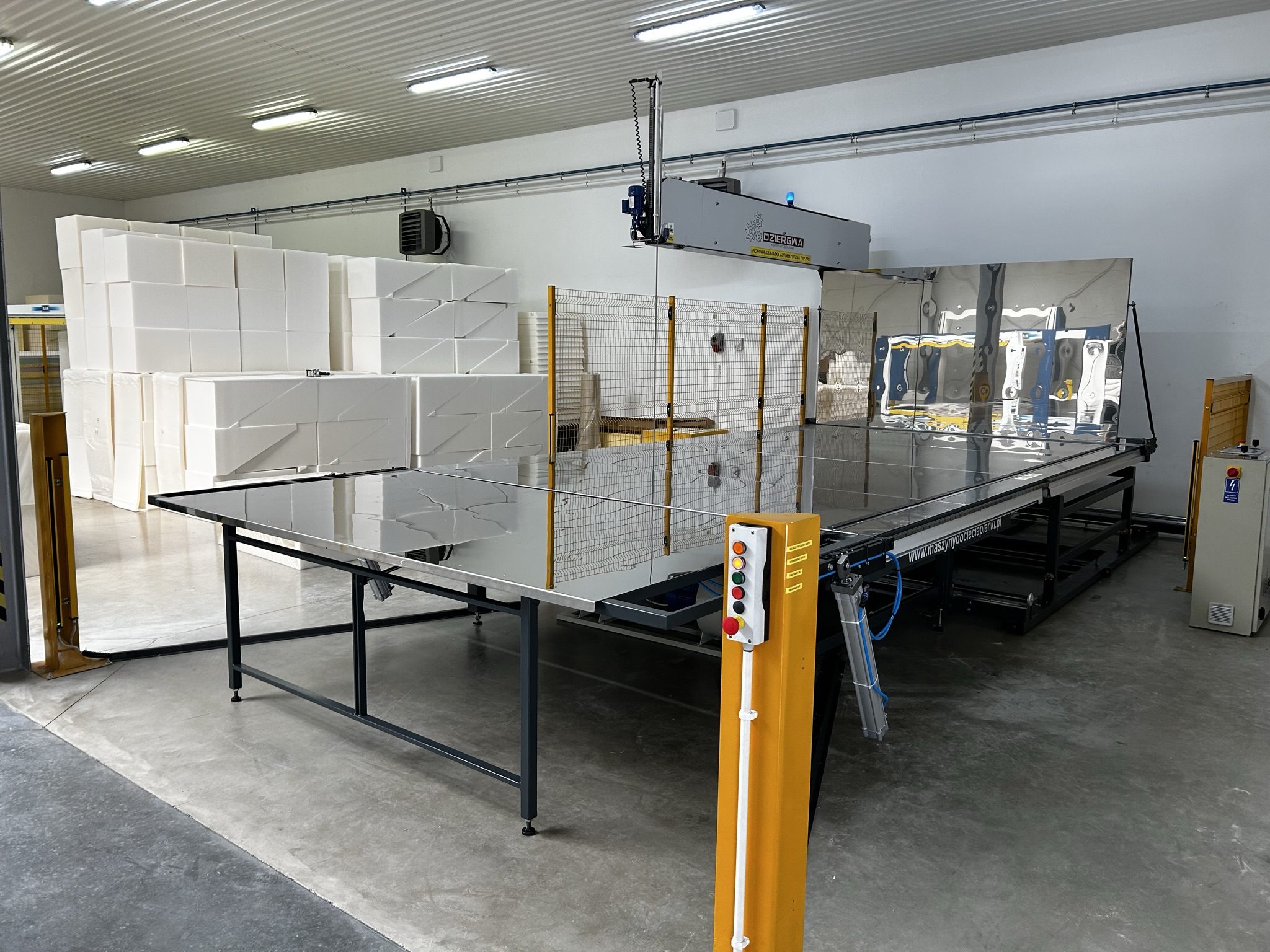
TL;DR: After production a foam block matures — it cools, off-gasses and stabilises dimensionally. Cutting too early gives sheets that later "move" in dimension and, in extreme cases, carries a fire risk, because a fresh block is hot inside. The standard in plants is curing measured in days, storage with a gap between blocks and at a stable temperature. A foam store is not just a place — it is part of the cutting technology.
Why must a foam block cure before cutting?
A freshly produced block is hot inside and reactions are still taking place in it — until it cools and off-gasses, its dimensions and hardness keep changing. Cutting such a block gives an apparently correct result: the sheet comes out to size, but a few days later it shrinks or distorts. The second reason is safety: the core of a polyurethane block can hold a high temperature long after it leaves the mould, and foam is a flammable material. Curing is therefore not a matter of storage convenience but a condition of product stability.
How long are blocks cured?
In practice at least twenty-four hours is assumed, and for large, dense blocks several days, until the core temperature equals the hall temperature. Rules that work in plants:
1. A gap between blocks — free air flow, no tight stacking.
2. Core temperature check — measured inside the block, not on the surface.
3. Stable hall temperature — fluctuations accelerate distortion.
4. Protection from light — UV causes surface yellowing.
5. Away from ignition sources — foam is flammable, and a fresh block especially so.
6. Marking the production date — without it curing cannot be enforced.
How to store foam without losing dimension?
A block must be stored on a flat, clean surface, without point loading and without stacking beyond the material's strength — foam under load deforms permanently. The most common mistake is stacking blocks directly on one another: the lower layers lose height, and the deformation only shows up during cutting as uneven sheet thickness. The second mistake is storing sheets after cutting in tall piles — soft upholstery foams take a set within a few days.
- Core temperature — Risk if neglected: fire risk, unstable dimension; Good practice: measurement before cutting
- Curing time — Risk if neglected: sheets shrink after cutting; Good practice: a day or more, depending on the block
- Stacking method — Risk if neglected: permanent deformation; Good practice: gaps, limited height
- Humidity and UV — Risk if neglected: yellowing, surface change; Good practice: covered hall, no direct light
- Batch marking — Risk if neglected: no control of material age; Good practice: date and batch on every block
How does curing affect cutting quality?
A block with an even temperature cuts evenly, while a block with a hot core offers different resistance in the middle than at the surface — hence the "barrel" shape in the sheet cross-section. If sheets regularly come out thicker in the middle or at the edges, before you start looking for a machine fault, check the age and temperature of the material. It is a cheap diagnosis that often closes the subject. If the problem remains after ruling that out, the next steps are described in the articles on automating measurement and foam cutter breakdowns.
FAQ
Does mineral wool also need curing? Not in the same sense as foam — wool does not off-gas or cool for days. It does, however, need protection from moisture and crushing. Details in the article on mineral wool cutting parameters.
How can you tell a block is ready to cut? By the core temperature equalising with the ambient temperature and by the perceptible off-gassing smell ceasing. External appearance alone is not enough.
Does curing change foam hardness? Yes, parameters stabilise during maturation. Hardness measured immediately after production may differ from the target value.
Planning a store and a cutting station from scratch? See the DZIERGWA machine range or write to us — we will advise on the hall layout. Read also: Machine for cutting upholstery foam and Safety at foam cutting machines.
Contact us — we'll be happy to advise and prepare an offer tailored to your needs!