
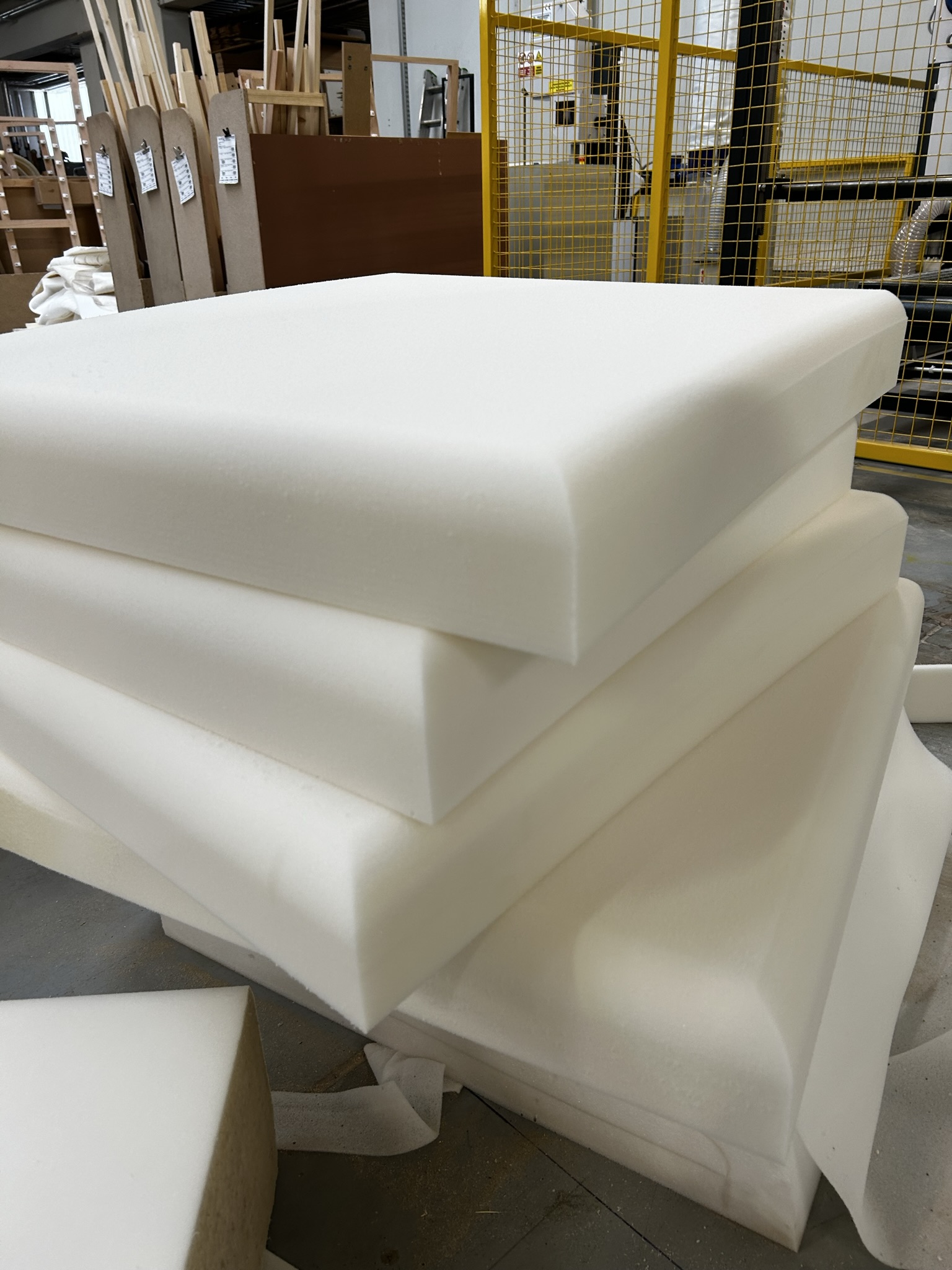
TL;DR: A machine for cutting upholstery foam is most often a horizontal cutter (sheets to size) or a vertical one (squaring the block and cross-cutting). Three parameters decide for an upholsterer: cutting range matched to the block, thickness tolerance and repeatability across a batch. In practice a furniture workshop starts with a horizontal machine with a feeder and adds a vertical one as the number of parts grows. Upholstery foams usually have densities of 18–35 kg/m³ and hardness from soft T18 up to HR — the softer the foam, the more blade tension and sharpness matter.
Which machine works best for upholstery foam?
A horizontal cutter is the usual choice for upholstery foam, because an upholsterer mainly needs sheets of repeatable thickness — and that is exactly what horizontal cutting does. The block is fed onto the table and a band knife slices off successive layers of the set thickness. A vertical cutter complements it: it squares the block to width and length, trims the sides and prepares material for further operations. In a workshop making seats, backrests and mattress inserts at the same time, both machines work as a pair — the horizontal one delivers the sheet, the vertical one delivers the dimension.
A third option is a CNC contour machine, needed only once shapes appear in the range: profiled seats, rounded backrests, inserts with a variable cross-section. For simple rectangular parts it is more capability than the job requires.
Which parameters matter with upholstery foam?
With upholstery foam what counts is cutting range, sheet thickness tolerance, batch repeatability and how the material is held down — because soft foam deforms under the pressure of the blade. What to look at when choosing:
1. Cutting range — it must cover the block you actually work with (typically 1000–2200 mm wide).
2. Thickness tolerance — for upholstery sheets around ±1 mm is the usual reference; with very soft foam the real tolerance grows.
3. Repeatability — critical in batches; it comes from frame rigidity, guide quality and the measuring system.
4. Band knife drive and tension — soft foam is less forgiving than rigid foam; a slack blade leaves a wave on the edge.
5. In-cycle sharpening — keeps edge quality stable through a whole shift.
6. Material feeding — a conveyor or hold-down stops the block from creeping.
How does cutting soft foam differ from rigid foam?
Upholstery foam is soft and springy, so it deforms ahead of the blade — which is why it needs a sharper knife, lower hold-down pressure and a different speed than rigid foam or mineral wool. In practice: with foam of 18–25 kg/m³ excessive pressure produces a wedge-shaped cross-section, and a blunt blade leaves fuzz on the edge. HR and high-resilience foams recover more slowly, so measurements must be taken after the material has relaxed, not straight after cutting. We covered this in more detail in the article on upholstery foam densities and hardness.
Machine selection for typical upholstery jobs
- Sheets for seats and backrests — Recommended machine type: horizontal cutter (PARK/PPAB); Why: repeatable thickness, works with the whole block
- Squaring the block to size — Recommended machine type: vertical cutter (PPA); Why: cross-cutting, fast trimming of the sides
- Profiled seats, shapes — Recommended machine type: CNC contour cutter (KPO); Why: cutting along a contour from a file
- Small workshop, mixed orders — Recommended machine type: semi-automatic (PPRK); Why: lower entry threshold, manual operation
- Mattress inserts in batches — Recommended machine type: line with a conveyor; Why: continuous feeding and take-off
What does it cost to move to machine cutting?
The entry threshold starts with a semi-automatic machine and rises with automation of feeding, measurement and control — which is why selection starts from the real number of parts per shift, not from a feature list. A workshop cutting several dozen sheets a day recovers the cost mainly in time and in waste: hand cutting produces more offcuts and more parts outside tolerance. In larger batches it is no longer the machine that counts but the cycle: load the block, cut, take off, stack. More on the calculation in the article how much a foam cutting machine costs.
FAQ
Is one machine enough for a whole upholstery operation? In a small workshop usually yes — a horizontal cutter covers most orders. With a mixed range a vertical machine for squaring the block soon follows, because otherwise squaring becomes the bottleneck.
What thickness tolerance is realistic with upholstery foam? For typical foams of 18–35 kg/m³ the usual reference is around ±1 mm with a correctly tensioned and sharpened blade. The softer the foam and the higher the hold-down pressure, the easier it is to lose that tolerance.
Will a foam machine handle mineral wool? That is a different material and a different working regime — wool is abrasive and dulls the blade faster. Dedicated machines are used for it, described in the article on the mineral wool cutting machine.
Want to match a machine to your foam and batch size? See DZIERGWA automatic machines and manual cutters, or write to us — we will suggest a configuration. Read also: Horizontal foam cutting machine — PARK and PPAB and Cutting foam to size — tolerances.
Contact us — we'll be happy to advise and prepare an offer tailored to your needs!