
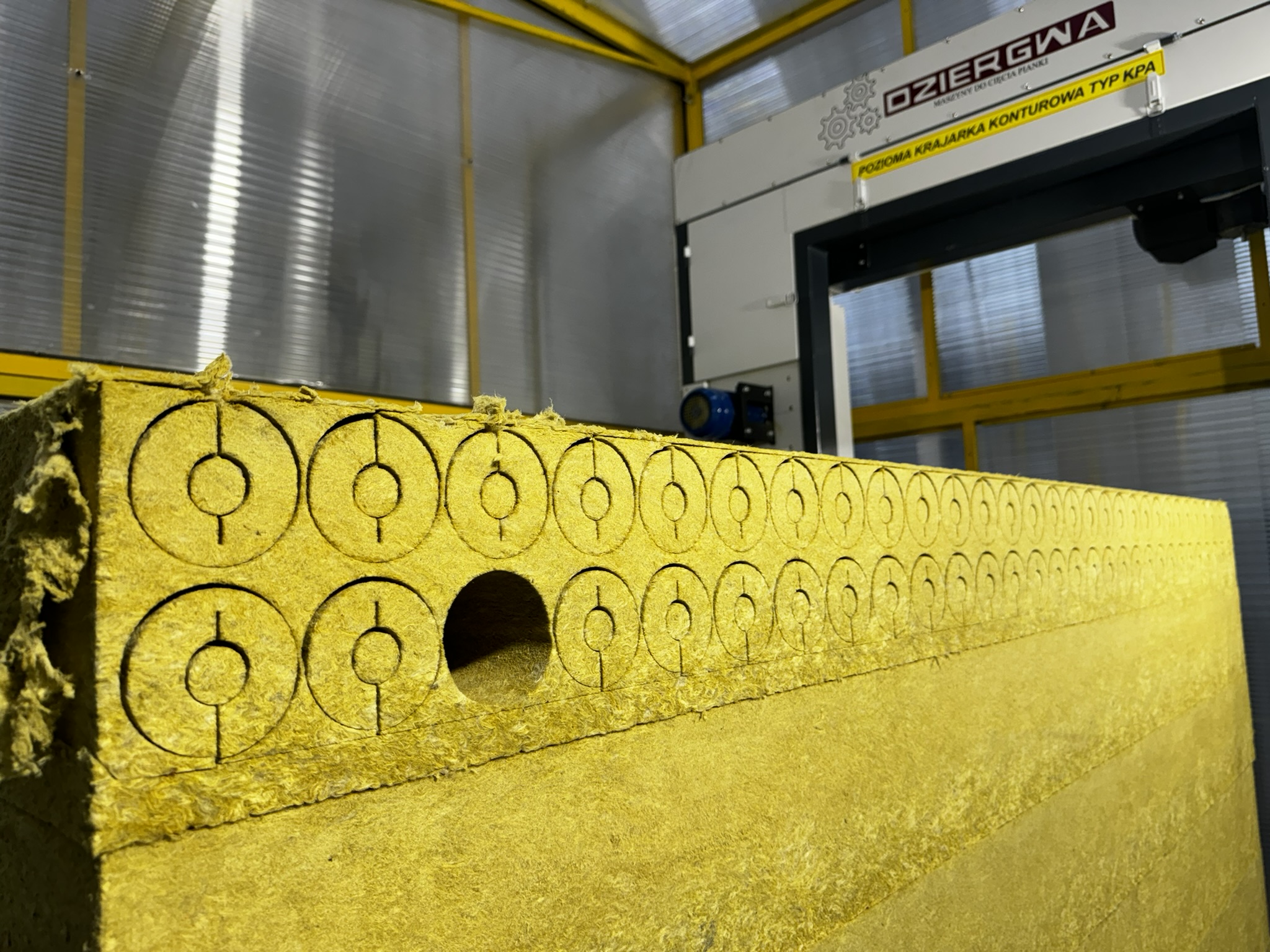
TL;DR: A machine for cutting mineral wool is a device designed for hard, abrasive and highly dusty material - unlike foam cutters, it needs hard, wear-resistant blades, a reinforced knife drive and an efficient dust extraction system. DZIERGWA builds dedicated machines for mineral wool (rock and glass), which cut slabs and blocks with a repeatability of ±1–2 mm, while protecting the operator and the mechanism against fiber abrasion.
Why mineral wool requires a different machine than foam
The polyurethane foam is soft and flexible - the knife passes through it with almost no resistance. Mineral wool (rock or glass) is a material with completely different characteristics: it is dense, fibrous, abrasive and very dusty when cut. A standard foam cutter will not cope with this load - the blade will quickly become dull and fine dust will penetrate the guides and bearings.
Therefore, the mineral wool cutting machine is a dedicated design in which the manufacturer takes into account three key challenges:
- dusting - cutting releases dust fractions harmful to the operator and the machine mechanics,
- blade abrasion - mineral fibers act like sandpaper and quickly wear out standard knives,
- extraction and occupational hygiene - an effective dust collection system at the source is necessary.
If you are just comparing cutting technologies of different materials, it is worth starting with a general guide to foam cutting machines and then move on to the specifics of wool.
Dust - operator safety and mechanics protection
The biggest operational difference when cutting mineral wool is dusting. Mineral dust is irritating to the respiratory tract and skin, and as an abrasive fraction it is deposited on all moving parts of the machine. Without proper protection, this shortens the life of linear guides, bearings and drives.
A well-designed mineral wool cutting machine solves this in two ways:
- dust extraction at the source - a hood or spigot at the cutting zone connected to the plant's filtering installation, collecting dust before it falls,
- sealing of sensitive elements - covers of guides and drives that limit the ingress of abrasive dust into the mechanism.
In practice, extraction is not an addition, but a necessary element - it determines both health and safety compliance and the durability of the investment.
Blade abrasion and knife drive
Mineral fibers dull tools much faster than foam. For this reason, wool machines use hard, abrasion-resistant blades and the cutting mode is selected according to the density and thickness of the board.
Types of cutting used for wool
- Band/oscillating knife with a hard blade - suitable for straight cutting of boards and blocks, where the resistance of the cutting edge to abrasion is important.
- Reinforced drive and knife tension - dense material has greater resistance, so the drive must have a reserve of power and the blade must have stable guidance to avoid pulling and loss of cutting geometry.
- Feed speed adjustment - slower, controlled feed for denser wool improves edge quality and reduces fiber tearing.
The key conclusion: blades are a consumable material with a shorter lifespan than in the case of foam, so easy blade replacement and a predictable service schedule have a real impact on the cost of cutting.
Parameters to pay attention to when selecting
When choosing a mineral wool cutting machine, it is worth combining it with a specific material and product dimensions. The most important parameters are:
- density and hardness of wool - from light glass wool to dense rock wool; the harder the material, the greater the requirements for the blade and drive,
- format and thickness - do you cut the boards into sheets or divide the blocks into given thicknesses,
- cutting accuracy - DZIRGWA maintains repeatability of ±1–2 mm, which in the case of insulating materials translates into tightness of installation,
- efficiency and continuity - whether you need a conveyor and continuous operation or cutting of individual elements,
- extraction and covers - dust protection range adapted to the scale of production.
A detailed list of settings and the influence of density on the cutting effect is described in the material about cutting parameters of mineral wool.
Control and repeatability
Regardless of the material, repeatability is the basis of mass production. DZIRGWA machines for mineral wool use CNC control with a touch panel, thanks to which the cutting program once entered can be reproduced without any deviations between batches. We use the same approach in foam cutters - more about the technology itself can be found in the article about CNC control in cutters.
As a result, the operator does not have to set the machine manually each time - he selects a saved program, and the machine maintains the set thickness and cutting geometry while maintaining an accuracy of ±1-2 mm.
Manufacturing applications
Mineral wool cutting machines are used wherever insulating material needs to be cut to repeatable formats:
- construction insulation - facade, roof and floor panels cut to size,
- prefabricated elements and panels - insulating elements for industrial buildings,
- acoustics - sound-absorbing inserts and panels,
- industry and ventilation - insulating fittings and laggings.
In each of these areas, one thing counts: a clean cutting edge, accurate dimensions and dust control at the station.
Summary and contact
A good mineral wool cutting machine is a combination of hard, abrasion-resistant blades, a reinforced knife drive, CNC control and - most importantly - effective dust extraction. These are the elements that distinguish it from an ordinary foam cutter and determine durability and operational safety.
DZIERGWA, as a Polish manufacturer, designs machines dedicated to mineral wool and selects the configuration for a specific material and performance. See mineral wool cutting machines in our offer or contact us - we will help you choose the machine, blades and extraction system for your production.
Contact us — we'll be happy to advise and prepare an offer tailored to your needs!