
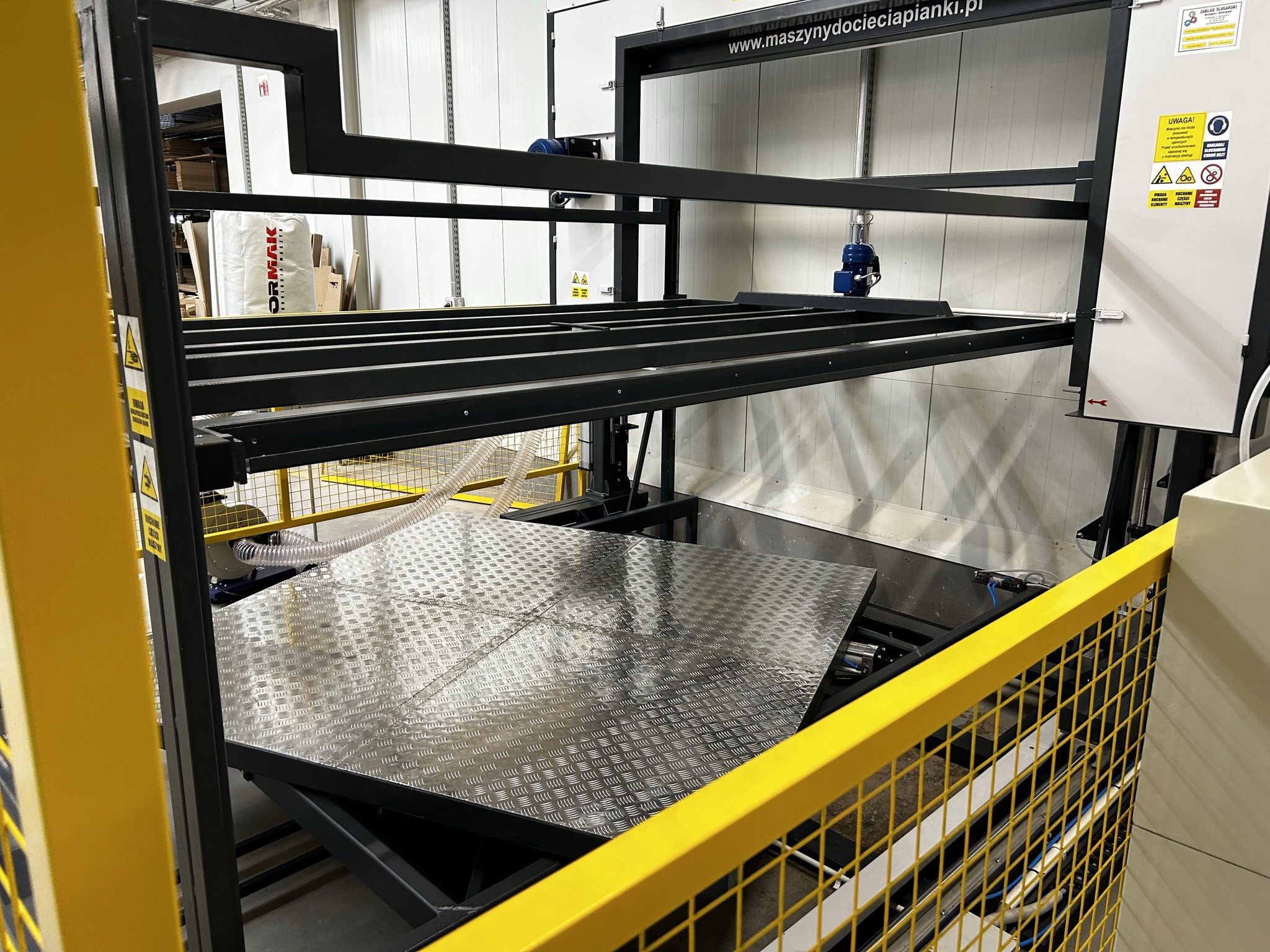
TL;DR: Repeatable sheet thickness does not come from the blade alone but from the measuring system: encoders, stops and the way the dimension is referenced. A linear encoder measures the real axis position, a rotary encoder measures drive rotation, and a mechanical stop gives a hard reference point. The most common cause of "floating" thickness is not electronics but mechanical play and material deformation — which is why automating measurement starts with machine rigidity, not with buying a sensor.
Where does the spread in sheet thickness come from?
Thickness spread has three sources: play in the mechanics, foam deformation under hold-down pressure and a reference error in the measurement — and they usually occur together. Foam is an elastic material: measured under pressure it gives a different result than after relaxing. If the machine references the dimension to the drive position rather than the real table position, every bit of gearbox play goes straight into the result. That is why troubleshooting checks, in order: mounting and play, blade tension, and only then the settings.
How does a rotary encoder differ from a linear one?
A rotary encoder measures the rotation of a drive element and converts it into displacement, while a linear one measures position directly — which is why the linear one does not "see" gearbox play and the rotary one does. The practical consequences:
1. Rotary encoder — cheaper, simpler to fit, sensitive to play and slip in the drive.
2. Linear encoder — measures what the operator cares about: real position; more expensive, needs protection from dust.
3. Mechanical stop — a hard reference point, excellent with repeatable formats.
4. Axis homing — establishing zero after start-up; without it the measurement has no reference.
5. Backlash compensation — a software correction that masks the symptom but does not remove the cause.
How to match the solution to the type of production?
Repeatable batches are best served by a stop and setting memory, variable production by linear measurement with a panel readout, and shape cutting by full CNC control with axis homing.
- A few fixed formats — Measuring solution: mechanical stops; Why: the cheapest route to repeatability
- Variable sheet thicknesses — Measuring solution: linear encoder + panel; Why: readout of real position, fast changeover
- Batches with recipes — Measuring solution: measurement + program memory; Why: the setting is recalled, not typed
- Contour cutting — Measuring solution: CNC with axis homing; Why: position in two axes, not a single thickness
- Very soft foams — Measuring solution: measurement + hold-down control; Why: limits deformation ahead of the blade
How to check machine repeatability in practice?
Cut a batch of at least ten sheets of the same thickness, measure each after the material has relaxed and compare the spread — that is the only reliable test, because a single measurement proves nothing. Always measure at the same points (centre and four corners) and note the order of the sheets: a growing error points to blade dulling or a warming drive, while a random spread points to mechanical play. It is worth repeating this test regularly, like the inspections described in the cutter maintenance schedule.
What does automated measurement give in numbers?
The real gain is a narrower thickness spread and shorter changeover — that is, fewer sheets out of tolerance and less time lost on setting up. With typical upholstery foams a tolerance of around ±1 mm is the usual reference; holding it by hand through a whole shift is difficult, but with measurement and recipes it becomes repeatable. The second effect is organisational: parameters stop being one person's knowledge. More on tolerances themselves: cutting foam to size.
FAQ
Is it worth adding an encoder to an older machine? It only makes sense if the mechanics are in good condition. A sensor on a machine with worn guides will show the error more precisely, but will not remove it.
Are mechanical stops an outdated solution? No — with fixed formats they are simple, fast and practically failure-free. They give way only where dimensions change often.
Why does the measurement after cutting differ from the setting? Most often because of the elastic deformation of the foam. Measure after the material has relaxed and without pressing the gauge — otherwise you are measuring pressure, not thickness.
Want repeatability you do not have to police by hand? See DZIERGWA automatic machines or write to us. Read also: Foam cutting machine with program memory and Foam cutter breakdowns.
Contact us — we'll be happy to advise and prepare an offer tailored to your needs!