
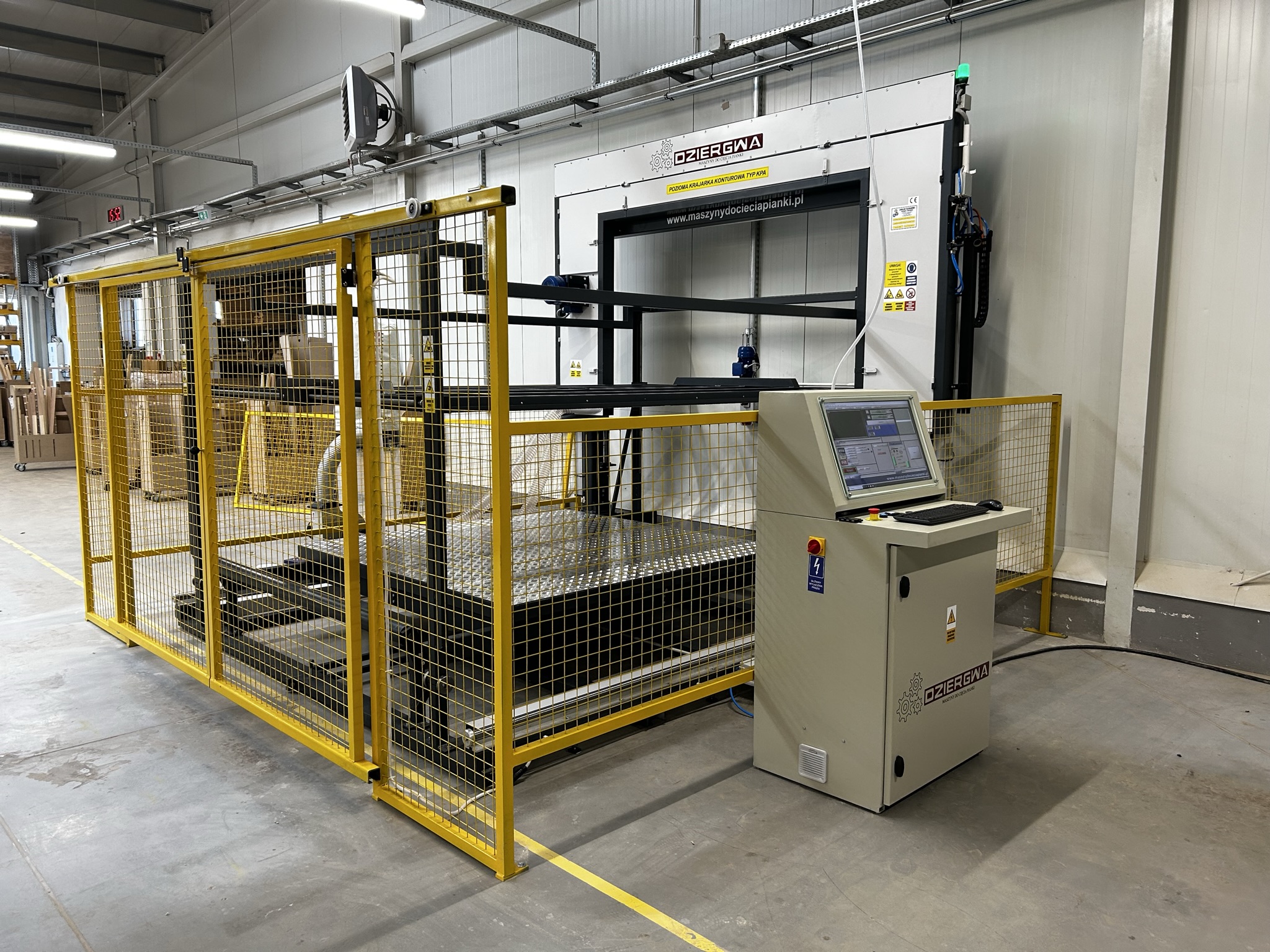
TL;DR: A "machine with memory" is a cutter whose CNC control stores cutting recipes — sets of thicknesses, lengths and sequences — and recalls them with a single choice from a list. The gain is not in the cutting itself but in changeover time and the elimination of operator mistakes. With repeatable orders, program memory can shorten batch preparation from a dozen minutes to a dozen seconds, and with orders returning every month it removes from the workshop the duty of remembering parameters.
What does "foam cutting machine with memory" mean?
It is a machine in which cutting parameters are saved as a named program and called from a list, instead of being set by hand for every order. In practice a program contains the thicknesses of successive sheets, the number of repetitions, the feed speed and the movement sequence. The operator picks an item on the panel, confirms and starts the cycle. The difference from a machine without memory is like the difference between a checklist and a note on a scrap of paper: parameters stop depending on who is standing at the machine today.
What does program memory actually give?
The biggest gain is shorter changeover and repeatability between shifts — and only secondly cutting speed itself. Specifically:
1. Shorter changeover — recalling a recipe instead of setting every value by hand.
2. Fewer errors — a parameter entered once and verified, rather than re-entered each time.
3. Repeatability of recurring orders — same customer, same dimension, same program.
4. Easier onboarding — a new person picks an item from a list instead of reconstructing knowledge.
5. A basis for costing — a program can be linked to a product index.
6. Less waste — a mistake in thickness usually means a whole sheet scrapped.
How does program memory differ from CNC control?
CNC control is the way the machine axes are driven, program memory is the way recipes are stored — each works without the other, but together they only make sense in repeatable production. A machine can have CNC and no convenient program library; it can also have simple setting memory without full contour control. In straight cutting (sheets, blanks) it is precisely the recipe library that matters most. In shape cutting the role of the recipe is taken over by the contour file, which we described in the article on CNC control in foam cutters.
Working with and without program memory
- Order repeating every month — Machine without memory: parameters recreated from notes; Machine with program memory: a saved recipe is recalled
- Change of operator — Machine without memory: risk of a different setting; Machine with program memory: the same setting regardless of shift
- Changeover between orders — Machine without memory: values set by hand; Machine with program memory: an item chosen from a list
- Dimension complaint — Machine without memory: hard to reconstruct how it was cut; Machine with program memory: the program shows the parameters used
- Onboarding a new person — Machine without memory: requires knowledge of parameters; Machine with program memory: requires the ability to pick a program
When does program memory not pay off?
It does not pay off where every order is different and nothing repeats — the recipe library grows and nobody uses it. A workshop doing only one-off, non-standard cuts will gain more from a convenient panel and fast value entry than from extensive memory. The boundary is practical: if within a month you repeat the same settings more than a few times, memory starts to earn its keep. The article on foam cutter throughput helps with that assessment.
FAQ
How many programs can a cutter store? It depends on the controller — in practice the number of slots is far larger than the real number of repeatable orders in a workshop. The bottleneck is naming discipline rather than a memory limit.
Can a program be transferred to another machine? If the machines have compatible controls — yes. With different controller generations it is safer to re-enter the recipe and verify the first sheet.
Does program memory replace quality control? No. It reduces setting mistakes, but it does not monitor blade condition or material deformation — the first sheet of a batch is still worth measuring.
Want a machine that remembers your cutting recipes? See DZIERGWA automatic machines or write to us. Read also: Touch panel in a CNC cutter and Automating measurement in a foam cutter.
Contact us — we'll be happy to advise and prepare an offer tailored to your needs!