
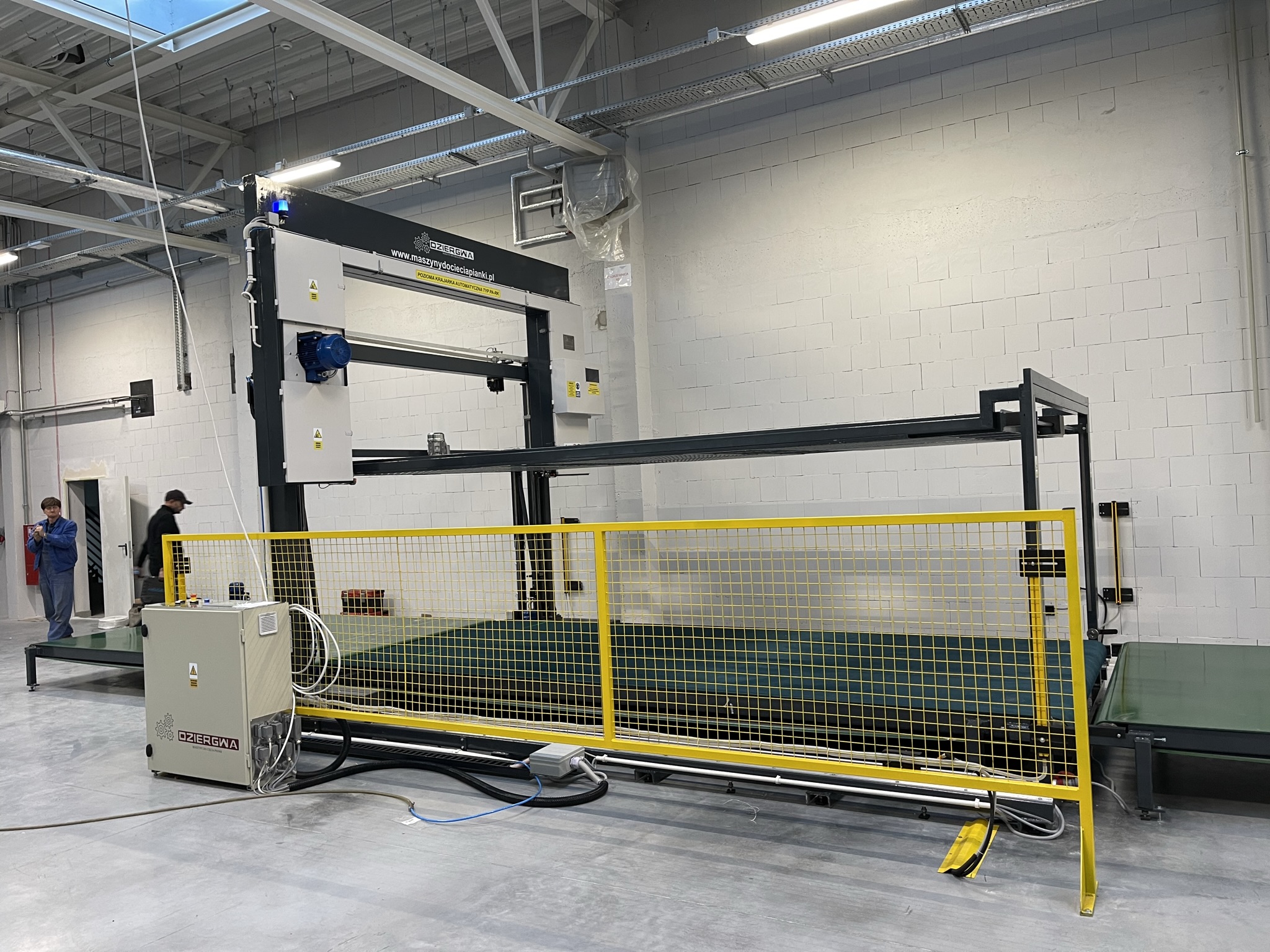
TL;DR: The most common failures of foam cutters are: breakage of the band knife, increase in guide resistance, cutting dimension errors and overheating of the CNC controller. Most can be prevented by regular maintenance - the schedule described in: Cutter maintenance - schedule 2026.
Failure 1: Band knife breakage
Symptoms: Sudden machine stop, broken blade alarm, characteristic noise or vibration before bursting.
Reasons:
- Too high knife tension (above the norm 200-250 N)
- Material fatigue during numerous repairs of knife joints
- Cutting material that is too hard without changing the parameters (high density foams >80 kg/m³)
- Knife hitting a foreign body in the foam block (snapped metal element, clasp)
Repair:
1. Turn off the machine and unlock the knife tensioner
2. Remove the broken knife fragments from the guides and wheels
3. Check the condition of the drive wheels (no damage from knife fragments)
4. Install the new band knife
5. Set the automatic pneumatic tension and make a test cut
Repair time: 30-60 minutes with spare parts available.
Failure 2: Increased resistance to movement of the sides
Symptoms: Uneven material feed, jerking while cutting, wavy pattern on the cutting surface, drive overload alarm.
Reasons:
- Neglected lubrication of linear bearings - foam dust absorbs the lubricant
- Linear bearing wear (axial play)
- Damage to the toothed drive belt
Repair:
1. Clean the guides from dust (compressed air)
2. Lubricate the linear bearings according to the operating instructions (LV lithium grease)
3. Check the timing belt tension and condition
4. If resistance persists - replace bearings (service activity)
Failure 3: Cutting dimension error (+/- a few mm)
Symptoms: The finished slices have a different thickness than the programmed one. Repeatable or random deviation.
Reasons:
- Plays in Z-axis ball or trapezoidal screws (height)
- Incorrect calibration of position encoders
- Foam compression under pressure - too much pressure
- Dull knife - material pushed out before cutting
Diagnostics and repair:
1. Measure the actual thickness of 10 samples with a caliper
2. Calculate systematic deviation (calibration offset) vs. random
3. Systematic deviation → recalibrate the position sensor in the CNC menu
4. Random deviation → check the screw looseness and the condition of the knife
Failure 4: CNC controller overheating
Symptoms: Sudden machine shutdown, controller restart, cabinet temperature error.
Reasons:
- Clogged control cabinet air filter (foam dust!)
- Damaged cabinet fan
- Too high hall temperature (>40°C in summer)
Repair:
1. Clean your cabinet air filter – a weekly chore
2. Check if the cabinet fan is working (noise, air movement)
3. In hot summer: provide additional ventilation of the hall near the control cabinet
Failure 5: Flatsides out of sync
Symptoms: The left and right sides move at different speeds, the material is fed obliquely, the cut is not parallel.
Reasons:
- Damage to the encoder (encoder) of one of the sides
- Broken drive connection cable
- Driver configuration error after update
Repair: Requires service diagnostics - contact DZIERGWA via WhatsApp (+48 723 882 783) or use AnyDesk remote diagnostics.
When to call DZIERGWA service?
Call service in case of:
- Electrical and electronic failures (controller, converters)
- Mechanical damage requiring welding or machining
- Failure after operation beyond the normative mileage without inspection
- When self-diagnosis has not produced results
Service contact: WhatsApp +48 723 882 783, AnyDesk remote diagnostics on request.
Frequently asked questions (FAQ)
Can a broken band knife damage the machine?
Yes, knife fragments can scratch the drive wheels or guides. Therefore, you should thoroughly clean the machine and check the condition of the wheels before installing a new knife.
How quickly does DZIRGWA respond to a service call?
In urgent matters, we usually respond via WhatsApp within hours. AnyDesk remote diagnostics often possible on the same day. On-site visit of a service technician - we agree the date individually, depending on the location.
Contact us — we'll be happy to advise and prepare an offer tailored to your needs!