
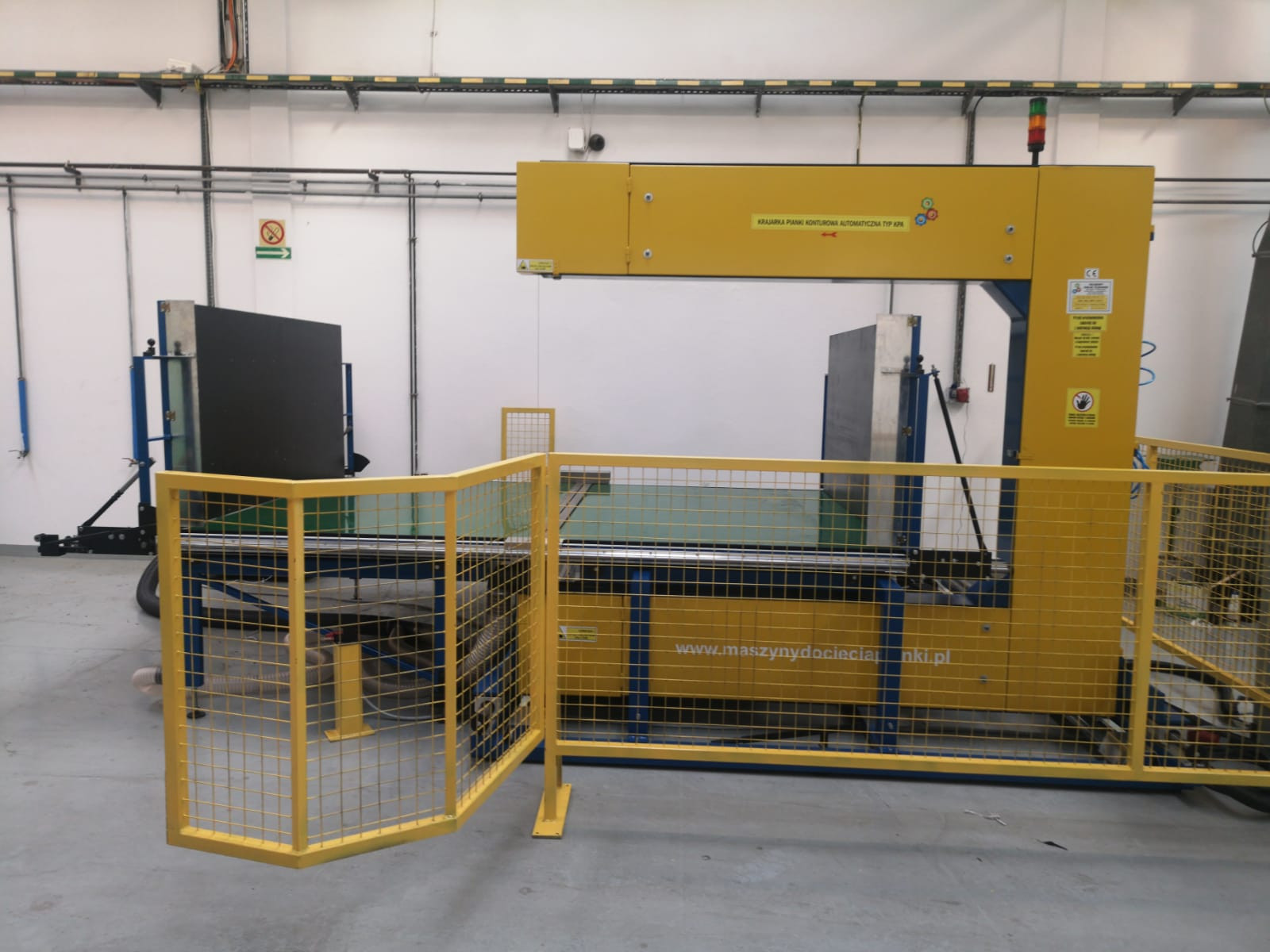
TL;DR: Polyethylene (PE) foam cuts differently from polyurethane: it is stiffer, compresses less and melts instead of dusting. For thin layers and rolls a band knife with the right geometry works well, for shapes — contour cutting, and with cross-linked foams (IXPE, XPE) blade temperature must be watched so the kerf does not weld shut. The most common mistakes are excessive feed speed and a blunt blade — both leave a fused, hard edge instead of a clean cut.
How does PE foam differ from PU foam when cutting?
PE foam has closed cells and higher stiffness than open-cell PU foam, so it does not yield in front of the blade — but it does heat up and can stick to it. Polyurethane "gives way" to the knife and springs back; polyethylene behaves more like a flexible plastic. The consequences are practical: less trouble with dimensional deformation, more with temperature and chip removal. With thin PE layers (2–10 mm) the material usually comes from a roll rather than a block — a completely different workstation logistic.
How to set cutting parameters for PE foam?
Three things are decisive: a sharp blade with the right geometry, moderate feed speed and cooling of the cutting zone — because excess heat turns cutting into welding. A set of good practices:
1. A sharp, clean blade — PE residue on the knife immediately degrades the kerf.
2. Lower feed speed than with PU — you give the material time to be cut, not melted.
3. Band knife tension — constant, with no slack; with stiff material slack shows on the edge at once.
4. Material support — PE sheets must be guided so they do not lift as the blade passes.
5. In-cycle sharpening — keeps blade geometry through the whole shift.
6. Offcut removal — PE is light and static, so it sticks to the machine easily.
Which machines suit PE foam?
Sheets and rolls of PE are handled by horizontal machines and winders, shapes by contour cutters, and foamed blocks by vertical machines, just as with polyurethane. The choice depends on the form of the material, not on the polymer itself:
- Foamed block — Machine type: vertical cutter (PPA); Technology note: squaring to size, as with PU
- Sheets and boards — Machine type: horizontal cutter (PARK/PPAB); Technology note: requires good sheet support
- Material from a roll — Machine type: line with unwinder and winder; Technology note: continuous cutting, tension control
- Shapes and mouldings — Machine type: CNC contour cutter (KPO); Technology note: contour cutting from a DXF file
- Thin IXPE/XPE layers — Machine type: blade with temperature control; Technology note: risk of welding the edge
Where is cut PE foam used?
PE foam goes mainly into technical packaging, insulation, tool inserts and underlays — that is, wherever a closed cell and moisture resistance matter. This distinguishes it from upholstery foam: the customer does not expect softness, but a repeatable shape and dimensional stability. Inserts for tool cases or transport nests are typical contour-cutting applications — more in the article on contour cutting of foam.
How to avoid a fused edge?
A fused, hard edge is almost always the result of excess heat: a blunt blade, too fast a feed or no chip removal. The order of checking is simple: first the blade (condition and geometry), then the speed, finally the material guidance. If after sharpening and slowing the feed the edge still sticks, the material is probably cross-linked and needs different blade geometry. We describe blade handling itself in the article on sharpening and replacing the band knife.
FAQ
Will a PU foam machine handle PE? Usually yes, but with different parameters: a slower feed and more frequent sharpening. The machine design does not change — the working regime and blade geometry do.
Why does PE foam stick to the blade? Because it melts before it is cut. That is a sign of too much heat in the cutting zone — most often from a blunt blade or excessive speed.
Can PE be cut with a hot wire? Wire cutting works well with materials that can be melted in a controlled way, but with PE it is easy to end up with a thickened, fused edge. You will find a comparison of methods in the article wire cutting vs band knife.
Do you cut technical foams and need a machine for a specific material? See the range of automatic machines or contact us — we will match the configuration and the blades. Read also: Processing technical and filter foams.
Contact us — we'll be happy to advise and prepare an offer tailored to your needs!