
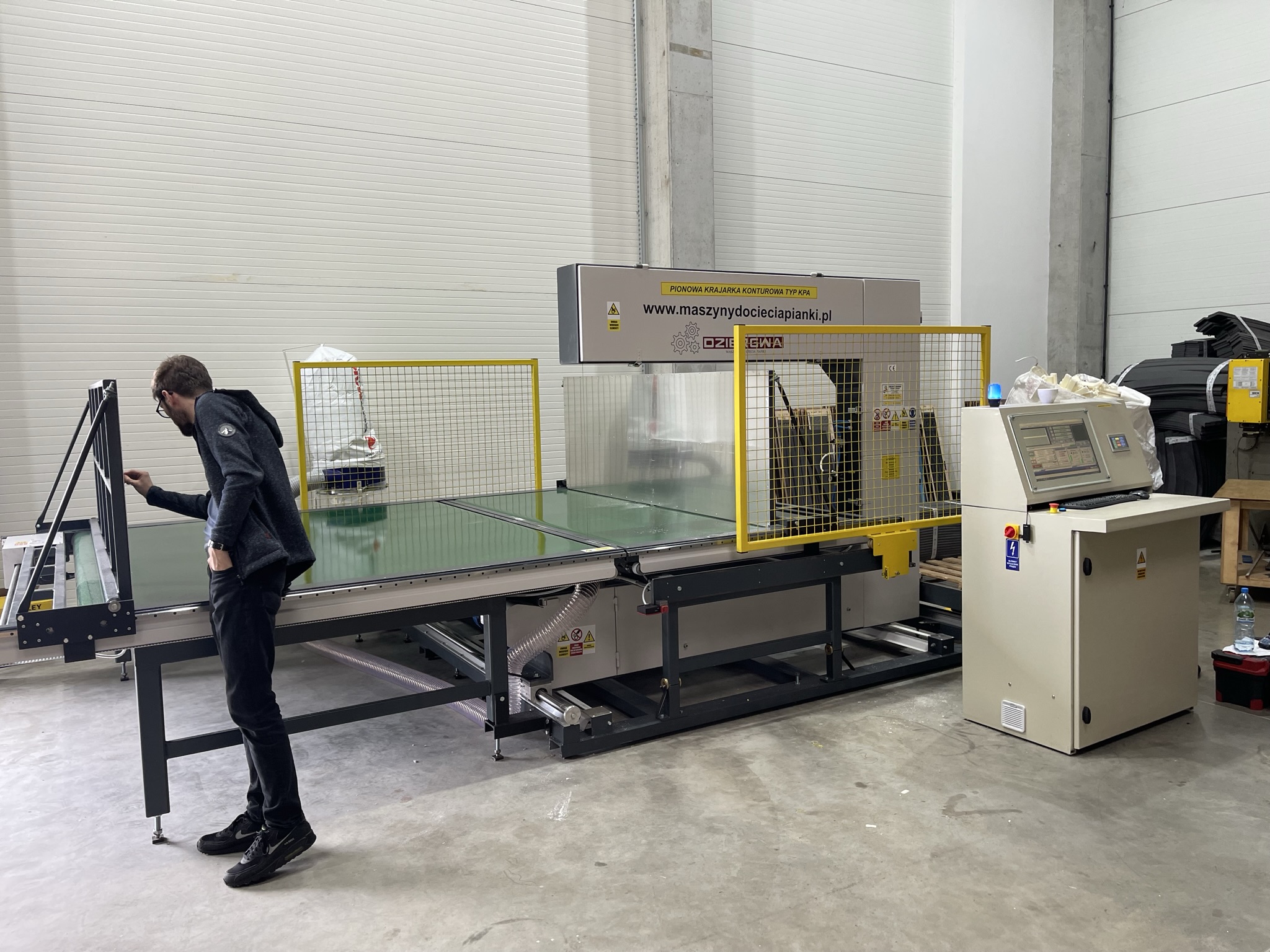
TL;DR: For straight cutting of foam blocks and sheets, a band knife is the best choice — it is fast, cheap to run and holds an accuracy of ±1–2 mm. For complex 3D shapes, profiles and contours, oscillating-blade (wire) cutting wins, reaching ±0.5 mm. In most furniture and mattress plants the band knife is the standard; oscillating cutting is used for profiled toppers, molded parts and shaped elements.
How does band-knife cutting work?
A band knife is a thin, closed steel blade running at 15–25 m/s and sharpened automatically during operation. It cuts through the foam block with almost no material loss (kerf below 1 mm), which makes the method very economical. DZIERGWA horizontal and vertical cutters (the PARK and PPA series) use this method to cut sheets, layers and to-size blanks.
A band knife is best suited to:
- cutting blocks into sheets and layers of constant thickness,
- squaring sheets into rectangular blanks,
- producing inserts for upholstered furniture and mattresses,
- cutting foam of 18–50 kg/m³ density at full speed.
How does oscillating-blade cutting work?
Oscillating-blade cutting uses a thin wire — vibrating or heated — guided along a set path, which produces shapes impossible to make with a band knife. The oscillating wire (vibrating at tens of Hz) cuts cold and works in CNC contour cutters such as the DZIERGWA KPO series. The method reaches ±0.5 mm and can cut wavy profiles, seat shapes and 3D elements.
Oscillating cutting is chosen for:
- 2D contours and 3D shapes,
- profiled toppers (e.g. egg-crate, wave),
- variable-section elements,
- small and medium runs with high repeatability.
Band knife vs oscillating cutting — comparison table
- Accuracy — Band knife: ±1–2 mm; Oscillating cutting: ±0.5 mm
- Cut type — Band knife: straight sheets, layers, blanks; Oscillating cutting: 2D/3D contours, profiles
- Speed — Band knife: very high; Oscillating cutting: medium
- Material loss — Band knife: minimal (<1 mm); Oscillating cutting: minimal
- Running cost — Band knife: low; Oscillating cutting: medium (wire, CNC control)
- Typical use — Band knife: furniture, mattresses, sheets; Oscillating cutting: shapes, toppers, seats
Which method should you choose?
If you mainly cut straight sheets and blanks, choose a band-knife cutter; if you produce shapes and profiles, you need an oscillating or CNC contour cutter. Many plants combine both: a band knife to slice the block into layers, and an oscillating wire for the final profiling. A middle-ground solution is a DZIERGWA hybrid cutter (the HPA series), which offers both horizontal and contour cutting in one machine.
FAQ
Which method is more accurate? CNC oscillating cutting is more accurate (±0.5 mm) thanks to numerically controlled wire guidance. A band knife holds ±1–2 mm, which is fully sufficient for sheets and blanks.
Can a band knife cut 3D shapes? Not fully. A band knife cuts in a straight line or gentle arc. For 3D shapes and profiles you need oscillating or CNC contour cutting.
Which method is cheaper to run? The band knife is cheaper — the blade is inexpensive and sharpening is automatic during operation. Oscillating cutting requires wire replacement and CNC maintenance.
Not sure which technology fits your production? See the DZIERGWA automatic machines and contour cutters, or contact us — we will match the machine to your material and product range.
Contact us — we'll be happy to advise and prepare an offer tailored to your needs!