
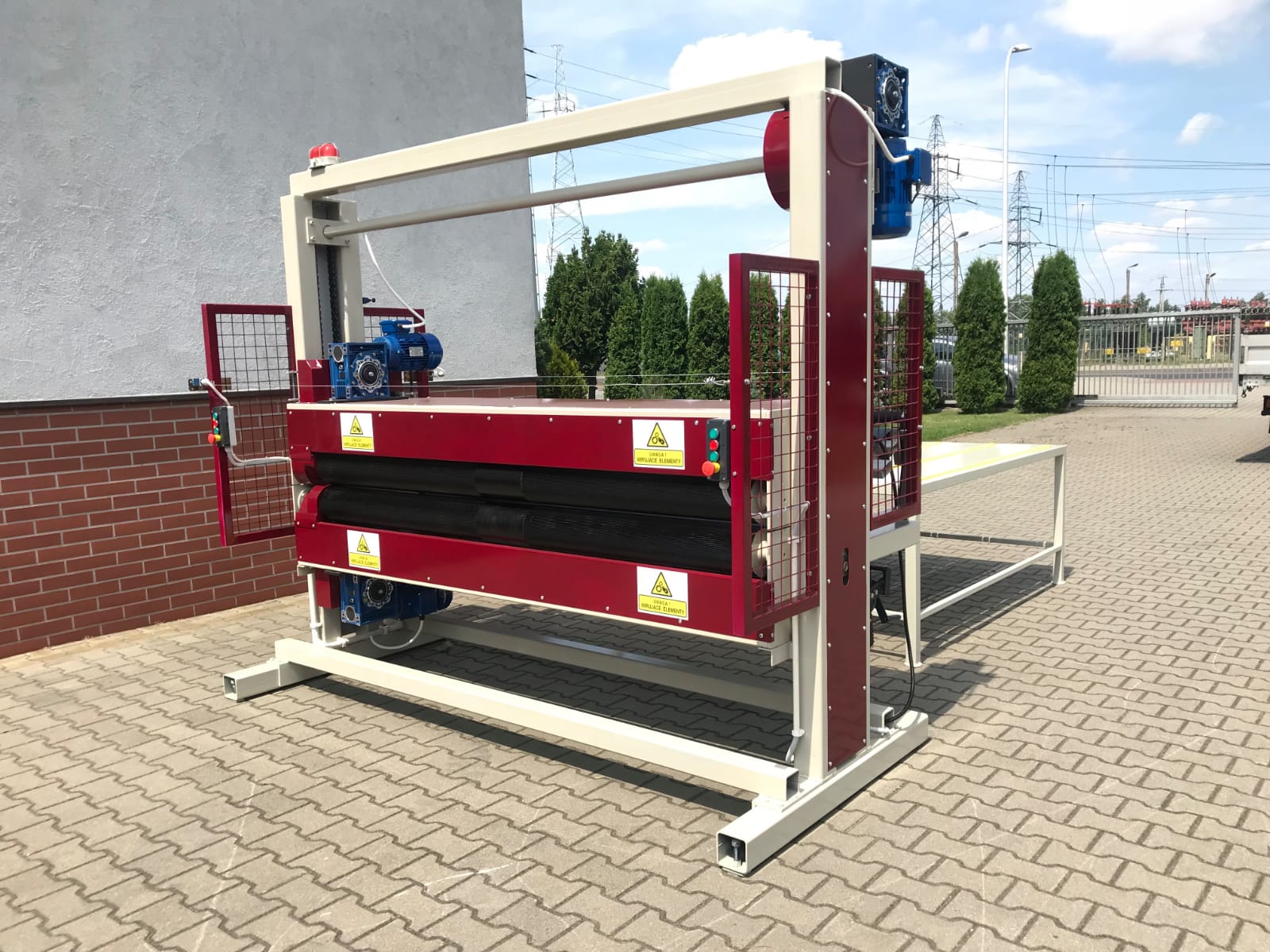
TL;DR: Foam on a roll is the result of continuous cutting — the block rotates, the blade slices off a thin layer and a winder rolls it up. This is how material from a few to several dozen millimetres thick is produced and sold by the metre. Three things are critical: stable tension, even thickness along the whole length and controlled winding, because an error spread over several dozen metres is far more expensive than an error on a single sheet.
How is foam on a roll produced?
The foam block is rotated and a band knife slices a continuous web of the set thickness from it, which goes straight onto the winder. This is a completely different logic from cutting sheets: instead of a series of single operations you have one long, uninterrupted kerf. That is why everything that is a detail with a sheet — minimal run-out, a small amount of play, slow blade dulling — accumulates along the whole length of the web in continuous cutting and is visible to the naked eye as varying thickness or waviness.
What determines the quality of rolled foam?
Web tension, speed stability and blade condition decide — and all three must stay constant along the whole length of the roll, not just at its start. What to watch:
1. Tension — too little gives folds during winding, too much stretches the material and reduces thickness.
2. Constant speed — changes in speed show up in web thickness.
3. Blade and in-cycle sharpening — with a long kerf the blade must be corrected as you go.
4. Web guidance — no sideways drift of the material.
5. Winding — even roll faces, no telescoping.
6. Marking and length — measurement of the currently wound length.
What is rolled foam used for?
Material on a roll goes wherever the customer cuts the shape themselves: upholstery, packaging, linings, underlays and sewn products. The roll format simplifies storage and transport — several dozen metres of web take a fraction of the space the same metres would take as sheets. For the producer it also means a different pricing policy: selling running metres rather than pieces. From the cutting plant's perspective it is a natural extension of the machine park described in the article on the horizontal foam cutting machine.
Sheet versus roll — what changes in production
- Nature of the work — Sheet cutting: single operations; Continuous cutting to a roll: one long kerf
- Critical parameter — Sheet cutting: thickness of a single sheet; Continuous cutting to a roll: thickness consistency along the length
- Effect of blade dulling — Sheet cutting: visible after a few sheets; Continuous cutting to a roll: builds up within one roll
- Product storage — Sheet cutting: large volume; Continuous cutting to a roll: compact rolls
- Sales — Sheet cutting: by the piece; Continuous cutting to a roll: by the running metre
- Scrap risk — Sheet cutting: a single sheet; Continuous cutting to a roll: a whole roll
How to limit scrap in continuous cutting?
Scrap is limited by checking during the run, not after the roll is finished — measuring thickness every few metres catches drift before it turns into several dozen metres of waste. Good practice is to record the starting parameters (speed, tension, blade condition) and run a short check after the first few metres. If thickness rises or falls steadily, the cause is usually the blade or drive temperature; if it changes in steps — the guiding mechanics. Offcuts and scrap sections are worth sending straight to the press, which we described with the foam waste press.
FAQ
What thicknesses are cut onto a roll? Most often from a few to several dozen millimetres. The thinner the web, the more tension and blade condition matter.
Can every foam be wound? Not every one — the material has to be flexible enough to roll without permanent creasing. Rigid and high-density foams usually stay in sheets.
Is the winder a separate machine? A winder may be integrated into the cutting line or be a separate unit taking the web. The choice depends on whether continuous cutting is a permanent process or an occasional one.
Want to start producing foam on rolls? See automatic machines and DZIERGWA additional equipment, or write to us. Read also: Foam cutter throughput.
Contact us — we'll be happy to advise and prepare an offer tailored to your needs!