
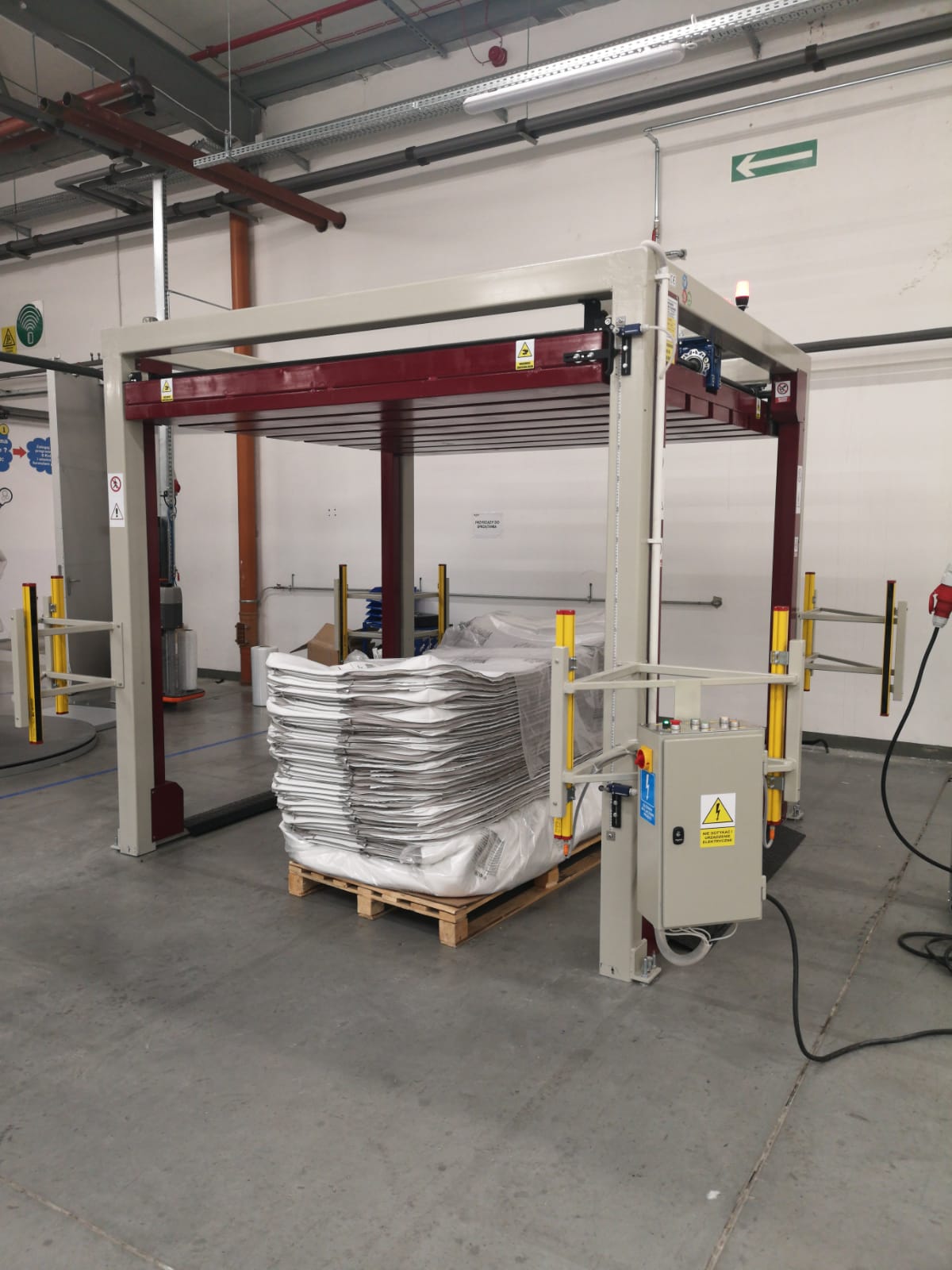
TL;DR: The foam waste baler compresses loose polyurethane cuttings and trimmings into compact bales or briquettes, reducing their volume by up to 5-10 times. Smaller volume means fewer car trips, lower disposal fees and a higher waste purchase price. For the production plant, this means real savings of several to several thousand zlotys per year on logistics alone.
Why does foam cutting cost so much
Polyurethane foam is light, but very "fluffy" - it takes up a lot of space with little weight. In practice, every plant that cuts blocks into slices, sheets or contours generates from a dozen to even 30% of waste in the form of trimmings, block remnants and blanks. The problem isn't the weight, it's the volume.
The consequences are tangible:
- Transport - the car is filled with loose foam before it reaches the load capacity limit. You transport air, you pay for full trips.
- Storage - bags and containers with loose scraps occupy the area of the hall that could be used for production.
- Utilization - waste collection companies often charge for volume or container, not per kilogram.
- Purchase - recyclers pay more for compressed, homogeneous raw material than for a loose mixture.
This is where the foam waste press comes in and eliminates the cost of "air transport".
How a foam waste press works
The principle is simple: loose cuttings go to the baling chamber, where a hydraulic or pneumatic piston crushes the material under great pressure. The compressed portion is tied or formed into a bale or briquette with repeatable dimensions, ready for palletization and transport.
Key features of a good solution:
- High compression - the greater the volume reduction, the fewer trips and containers.
- Repeatable bale format - easy palletization, better use of trailer space.
- Simple operation - loading, baling cycle, bale removal; minimal operator involvement.
- Durable construction - continuous operation in production conditions without failure.
Unlike cutting machines, the foam waste press does not cut - it closes the material circulation in the plant, managing what is left after cutting on machines such as vertical machines.
How much can you save - a detailed account
Let's assume a plant that generates waste filling 8 containers of loose foam per month, and collecting one container costs PLN 600.
- Without press: 8 containers x PLN 600 = PLN 4,800/month (PLN 57,600/year).
- With a press that reduces the volume 6 times: realistically approx. 1.5 containers of compact material equivalent = approx. PLN 900/month plus the possibility of selling the bale to a recycler.
In addition, there are savings on internal transport, fewer trips to the recipient and recovered warehouse space. The investment in a foam waste press usually pays off within a dozen or so months, and in large-volume plants - much faster.
Additional revenue from purchases
Compressed foam is a commercial commodity. Recyclers and producers of secondary foam (e.g. for regranulated mats) prefer a homogeneous, compact raw material with a predictable density. A bale is easier to weigh, transport and value than a bag of loose trimmings - which directly translates into a higher purchase rate.
Foam waste press in plant circulation
The greatest benefits come from connecting the press to a well-thought-out material flow:
1. Cutting on vertical, horizontal or [contour CNC] cutters (/en/oferta/maszyny-automatyczne) generates offcuts.
2. Collection of waste - containers or extraction systems are placed next to the machines.
3. Baling - the operator periodically empties the collection into the press.
4. Palletization and shipping - bales are placed on pallets for collection or disposal.
Some plants combine the press with a pillow stuffer, where some of the shredded offcuts return to production as filling - this allows for maximum closure of the cycle and reduction of waste at the source.
Is a foam waste compactor right for your facility
Break-even points are easy to assess:
- You generate a regular, repeatable stream of PUR foam shreds.
- You pay for disposal or transport calculated per volume/container.
- You lack storage space for loose waste.
- You want to sell waste to a recycler instead of paying for it.
If at least two of these points apply to you, a foam waste compactor will most likely reduce your operating costs. It is also worth combining it with the entire machine park - selecting a solution based on the actual volume and type of foam being cut.
You can find more about the effective management of scraps in the article about pressing foam waste, and about the selection of cutting machines - in the guide how to choose a foam cutting machine.
Summary
The cost of foam disposal and transportation is primarily the cost of its volume, not its weight. The Foam waste baler attacks the problem at the source: it crushes loose scraps into compact bales, reducing the volume several times, reducing collection and transport fees and opening the way to additional income from the purchase of secondary raw materials.
Do you want to estimate the savings potential for your plant? Contact DZIERGWA - as a Polish manufacturer of foam cutting machines, we will select a solution for your waste volume and help close the material cycle.
Contact us — we'll be happy to advise and prepare an offer tailored to your needs!