
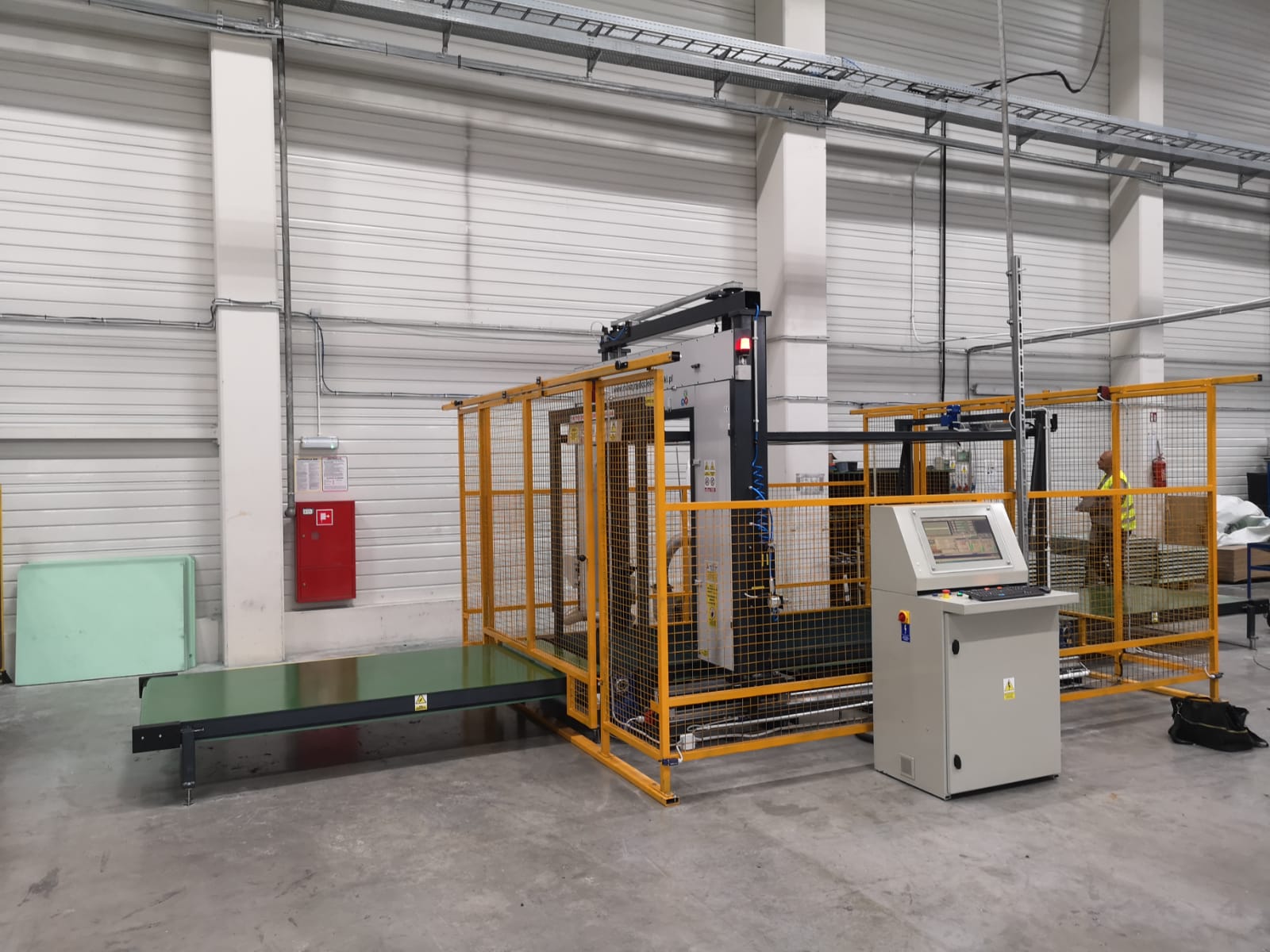
TL;DR: Outsourcing foam cutting is cheaper to start with, but it costs time and flexibility: every change of dimension means a new order and new transport. Your own machine starts to pay off once regular batches, short lead times or frequent dimension corrections appear. The practical threshold is not cubic metres, but the number of orders in which you have to wait for a supplier. Below is a calculation you can do yourself in a quarter of an hour.
When is a cutting service enough?
A service is enough when cutting is a rare event, dimensions are fixed and the deadline is not critical — that is, when you are not paying for waiting. A typical case: a few orders a year, a repeatable format, a supplier within reasonable distance. In that situation buying a machine freezes capital and adds duties (operation, sharpening, waste) that there is no reason to take on. A service is also the natural choice while a product is still being tested, before the volume has stabilised at all.
What does outsourcing really cost?
Beyond the price per cut you pay for transport both ways, for waiting time and for the inability to correct quickly — and it is usually that third item that hurts most. Components of the hidden cost:
1. Transport of blocks and finished sheets — foam is light but takes up a great deal of space.
2. Lead time — from order to collection; every day delays your own job.
3. Minimum batches — suppliers usually have an order viability threshold.
4. No correction on the fly — a mistake in dimension means another order cycle.
5. Waste on the supplier's side — you pay for material you never see.
6. Schedule dependency — your deadlines depend on somebody else's queue.
When does your own machine start to pay off?
Your own machine starts to pay off when cutting becomes part of the production cycle rather than a purchase — that is, when waiting for sheets blocks the next operations. Signals that the moment has come: weekly orders with a supplier, frequent dimension changes mid-job, a growing share of transport in the cost, deadlines dependent on an outside party. A second effect then appears: cutting in-house lets you use the offcuts that stay with the supplier. We write about handling waste in the article on pressing foam waste.
Service versus your own machine
- Start-up cost — Service: none; Own machine: investment in machine and workstation
- Unit cost — Service: fixed, higher; Own machine: falls with utilisation
- Lead time — Service: depends on the supplier; Own machine: depends on your own shift
- Dimension correction — Service: a new order; Own machine: a fix within the same hour
- Offcuts and waste — Service: stay with the supplier; Own machine: to be used by you
- Confidentiality of the pattern — Service: limited; Own machine: full
How to calculate the break-even point yourself?
Add up from the last six months: invoices for cutting, transport cost and the number of days you waited for material — and only then set that against a lease payment or the price of a machine. That third component is the key one, because it is most often omitted: a day of downtime costs more than the difference in cutting price. It is worth adding the real machine throughput per shift and the changeover time — the articles on cutter throughput and on how much a foam cutting machine costs will help. If financing is the barrier, the answer is often leasing of foam cutting machines.
FAQ
Can you start with a small machine and expand the park? Yes, and that is the typical path: a semi-automatic or horizontal machine to start, a vertical or contour machine in the next step as the range widens.
How much space does a cutting station need? Besides the machine itself you have to allow space for the block before cutting and the sheets after it — in practice a zone larger than the machine, plus extraction.
Does in-house cutting require extra formalities? The machine must meet safety requirements and carry a declaration of conformity; the workstation requires operator instruction. We collected this in the article on safety at foam cutting machines.
Wondering whether to keep cutting outside? Tell us how many sheets you make monthly and we will calculate it together. See automatic machines and manual cutters, or contact us.
Contact us — we'll be happy to advise and prepare an offer tailored to your needs!