
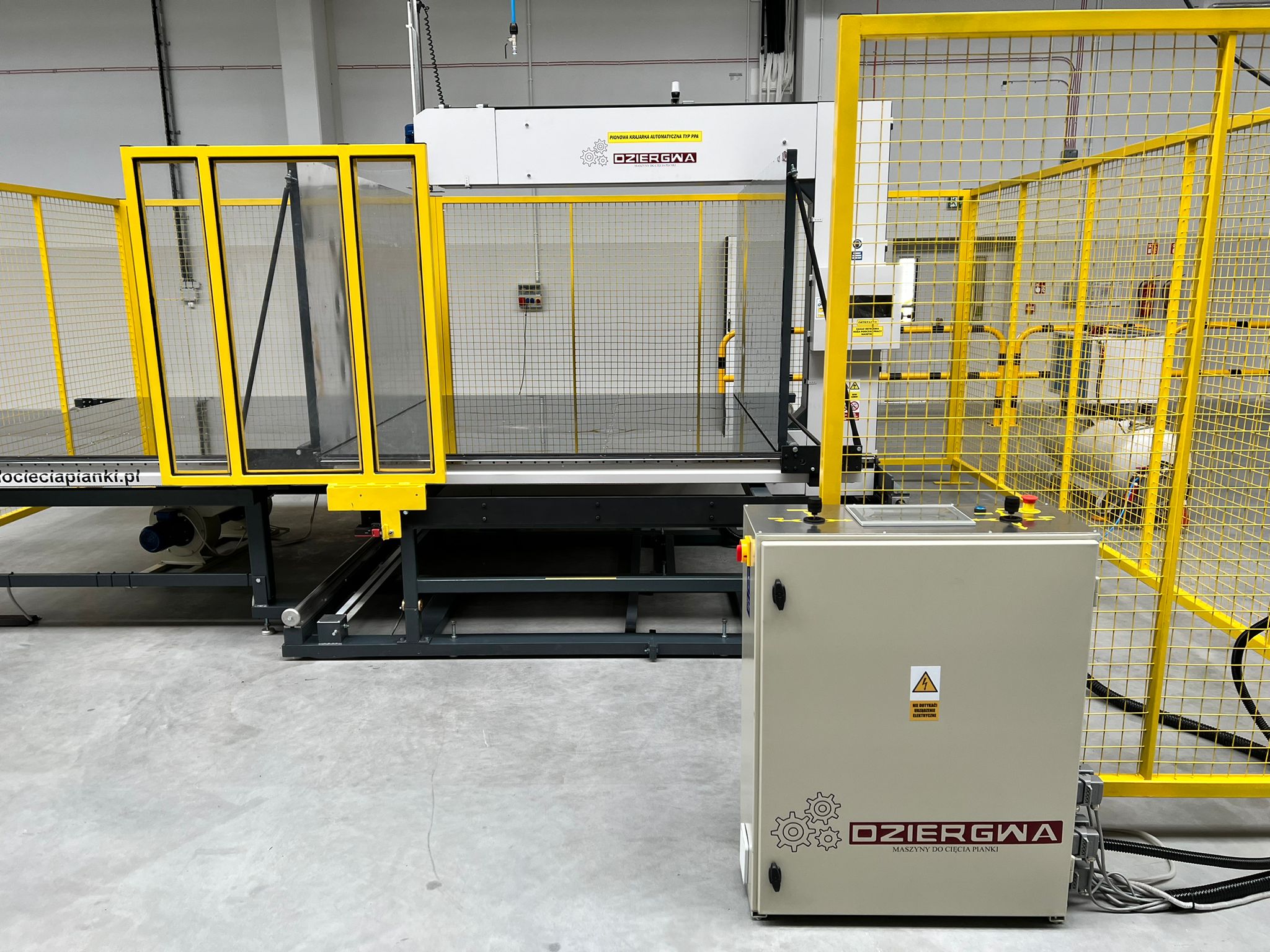
TL;DR: Polyurethane foam is difficult to recycle due to its cross-linked polymer structure. The dominant method is rebonding - crushing and gluing the offcuts into new blocks. Chemical recycling (glycolysis, hydrolysis) allows you to recover raw materials for the production of new foam. DZIERGWA cutting machines minimize the amount of waste at the source.
Why is recycling PUR foam a challenge?
Polyurethane foam (PUR) is a cross-linked polymer - long polymer chains are permanently connected by cross-links. This means that PUR foam cannot be melted and reformed like thermoplastics (PE, PP). This is a fundamental difference from, for example, EPS foam (styrofoam), which is easy to melt with granules.
In Europe, approximately 700,000 tons of PUR foam waste is generated annually (Europur 2024 data). Only some is recycled - the rest goes to landfills or incinerators.
Method 1: Rebonding - the most popular recycling of PUR foam
Rebonding involves grinding foam waste into small pieces (5-30 mm granules) and then compressing them under pressure with the addition of glue (polyurethane or latex) into the form of a new block.
Product: rebonding blocks with a density of 50-200 kg/m³ - higher than the initial foam.
Applications:
- Underlays for carpets and rugs
- Sports and fitness mats
- Acoustic underlays for floors
- Padding for transport seats
- Gymnastic mats and playgrounds
Efficiency: Up to 95% of foam waste can be recycled using the rebonding method.
Method 2: Mechanical recycling (regrind)
Small pieces of foam from production are ground into dust and added back to the new foam production process as a filler (up to 10-15% by weight). Foam with the addition of regrind has slightly different mechanical properties, but is cheaper to produce.
The method is used primarily for post-production waste - it is not suitable for used (post-consumer) foam.
Method 3: Chemical recycling - the future of the industry
Glycolysis: the foam is decomposed by glycols at high temperatures (180-250°C) into a polyol mixture that can be reused as a raw material for the production of new PUR foam. Polyol recovery at the level of 50-70% of the initial mass.
Hydrolysis: decomposition of foam using pressurized steam. A more expensive process, but produces a purer product.
Aminolysis and solvolysis: alternative methods of chemical decomposition, still at the stage of industrial scaling.
Chemical recycling is a priority of the European Chemical Recycling Alliance strategy - by 2030, it is assumed that 200,000 tons of PUR foam will be chemically recycled per year in Europe.
Method 4: Thermal disposal with energy recovery
PUR foam has a calorific value of 25-28 MJ/kg (comparable to coal). Incineration in modern energy recovery plants is a last resort - material methods are preferred.
How do DZIERGWA cutting machines support recycling?
Minimizing waste at the source: optimal cutting programs in DZIERGWA CNC machines reduce waste to a minimum. Less waste = less material to recycle = lower overall costs.
Precision cutting of rebonding blocks: Recycled blocks require the same precision cutting as new foam. DZIERGWA cutting machines handle rebonding blocks with a density of up to 200 kg/m³ - with appropriately selected knife parameters.
Waste granulation machines: DZIERGWA builds foam shredders - specialized machines that break waste into granules for rebonding or regrinding.
Legal regulations and PUR foam recycling in the EU
The Ecodesign Directive (ESPR) and the Packaging Regulation (PPWR) introduce requirements on the content of recycled materials in new products from 2025. The furniture and mattress sector is under increasing pressure to use foams containing recyclate.
Furniture and mattress manufacturers in Poland are increasingly asking DZIERGWA for machines adapted to cutting recyclate foams - a clear trend in 2025-2026.
Frequently asked questions (FAQ)
Can old furniture with PUR foam be recycled?
Yes, but post-consumer foam requires separation from fabrics and metal frames. After cleaning, it can be sent for rebonding or chemical recycling.
Can the DZIERGWA cutter cut rebonding blocks?
Yes. DZIRGWA machines are adapted to the parameters of the client's specific material. Higher density rebonding blocks require reinforced drives and appropriate knife parameters - we select them individually.
Where to dispose of PUR foam waste from production?
Companies that purchase PUR foam waste operate throughout Poland. For large volumes (over 1 tonne/month), it is worth organizing direct collection - many rebonding companies pay for good quality post-production offcuts.
Contact us — we'll be happy to advise and prepare an offer tailored to your needs!