
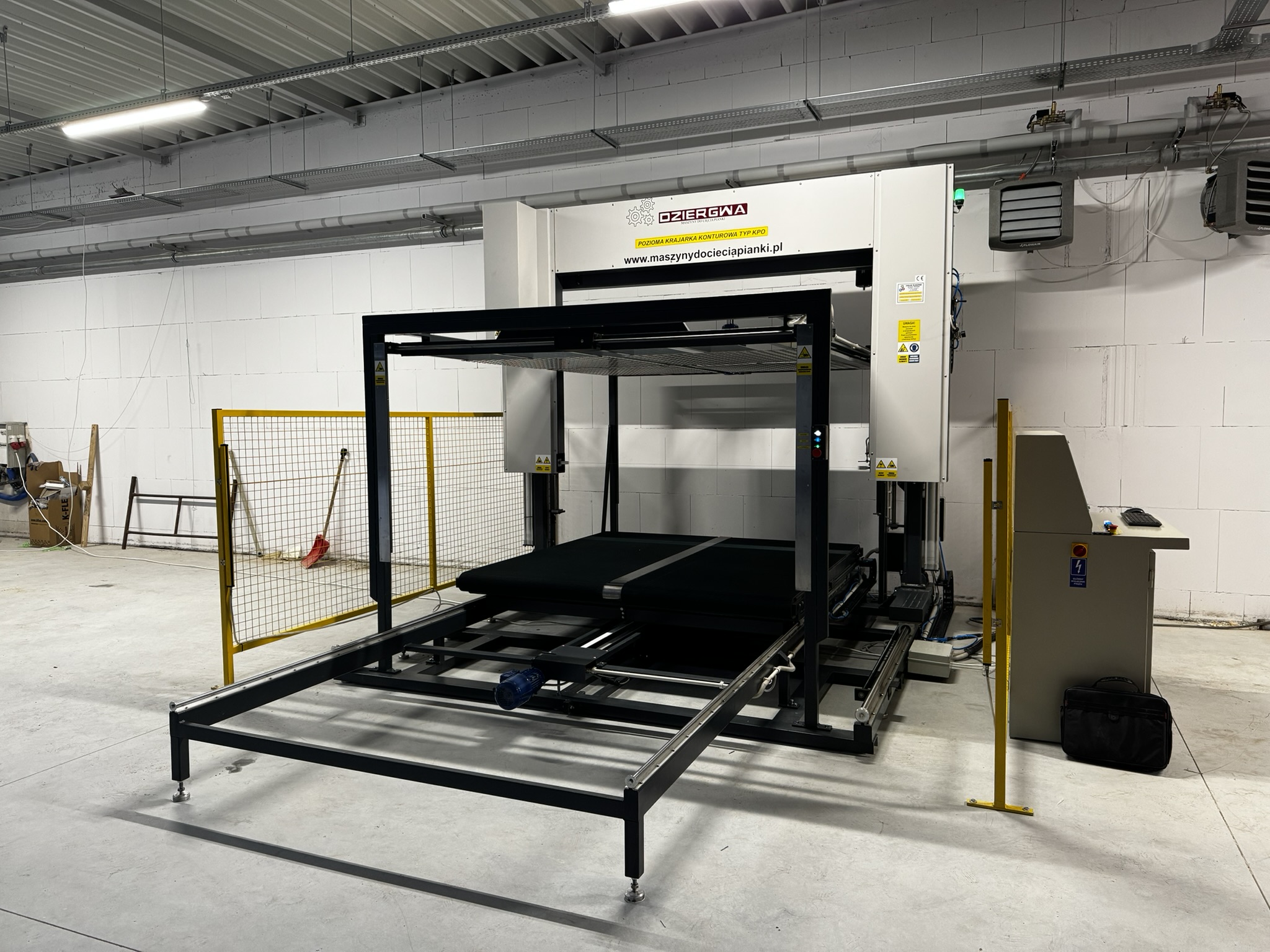
TL;DR: A horizontal foam cutter is an industrial machine in which the cutting body moves horizontally over a block of foam. The ability to cut a thin layer from 7 mm, automatic pressure and belt conveyor make it a key device in the production of mattresses and thin foam boards.
Principle of operation of the horizontal cutter
In a horizontal cutter, the foam block rests stationary on the work table. The cutting body equipped with a band knife or string moves horizontally over the material, cutting subsequent layers from the top of the block. The cutting height is programmed via the vertical axis (ball or trapezoidal screws).
Unlike a vertical cutter (where the material moves through the knife), in a horizontal cutter the knife moves over the material. This solution allows cutting thin sheets from 7 mm - much more difficult or impossible on vertical cutters.
Why is a conveyor belt crucial?
DZIERGWA horizontal cutting machines type PARK are equipped with a belt conveyor which:
- Automatically feeds foam blocks onto the work table
- Receives finished sheets and stacks them
- Reduces cycle time by 30-50% vs. manual loading
- Allows one operator to work instead of two
In continuous mattress production, the conveyor belt is the key to maintaining high efficiency - the operator does not have to carry blocks weighing 100-300 kg.
Automatic pneumatic clamp - precision in thin cuts
To cut a 7-20 mm thick sheet from a foam block, the material must be perfectly stabilized. Even minimal block vibrations result in a wavy cutting surface.
The PARK cutter uses automatic pneumatic pressure - the pressure plate lowers and maintains constant pressure on the block throughout the cutting process. The pressure is adjusted depending on the hardness of the foam - too much pressure compresses the foam and changes its size, too little - it allows vibrations.
Cutting precision with pneumatic pressure: ±1 mm with proper machine calibration.
Models of DZIERGWA horizontal cutters
PARK type - basic model with a conveyor, pneumatic clamp and CNC controller. Supports blocks up to 2000×1200×1200 mm.
PPAB type - version with additional automation: automatic block rotation, synchronization with the block warehouse. For large mattress plants.
Type PPRK (semi-automatic) - simplified horizontal cutter without a full conveyor. Designed for smaller volumes and upholstery workshops.
Comparison with vertical cutter
Horizontal and vertical cutters complement each other. Detailed comparison in the article: Vertical foam cutter.
- Horizontal cutting machine = thin sheets, continuous production of mattresses, minimum thickness 7 mm
- Vertical slicing machine = quick cutting of blocks into thicker slices, easier operation, lower cost
Many mattress manufacturers have both machines - a vertical one for the initial division of blocks and a horizontal one for final sizing of thin sheets.
Applications of the horizontal cutter
- Mattress production - comfort layer sheets 7–30 mm
- Technical foams - 5-50 mm boards for packaging and seals
- Automotive industry - thin upholstery inserts
- Building insulation - PIR/PUR boards up to 50 mm (special versions)
- Textile materials - cutting foam for clothing and footwear
Frequently asked questions (FAQ)
What is the minimum cutting thickness in the PARK horizontal cutter?
Standard 7 mm. In special versions with additional pressure, it is possible to cut from 5 mm, but this requires individual configuration of the machine.
Is the horizontal cutter suitable for PIR (hard) foam?
Yes, using appropriately reinforced guides and a more powerful drive. PIR foam is harder - the machine must have extra power. DZIERGWA selects the drive parameters for the client's specific material.
How many blocks of foam can be processed per hour?
Efficiency depends on the cutting thickness and block dimensions. Typically, the PARK cutter processes 4-10 blocks per hour when cutting into 50-100 mm sheets.
Contact us — we'll be happy to advise and prepare an offer tailored to your needs!