
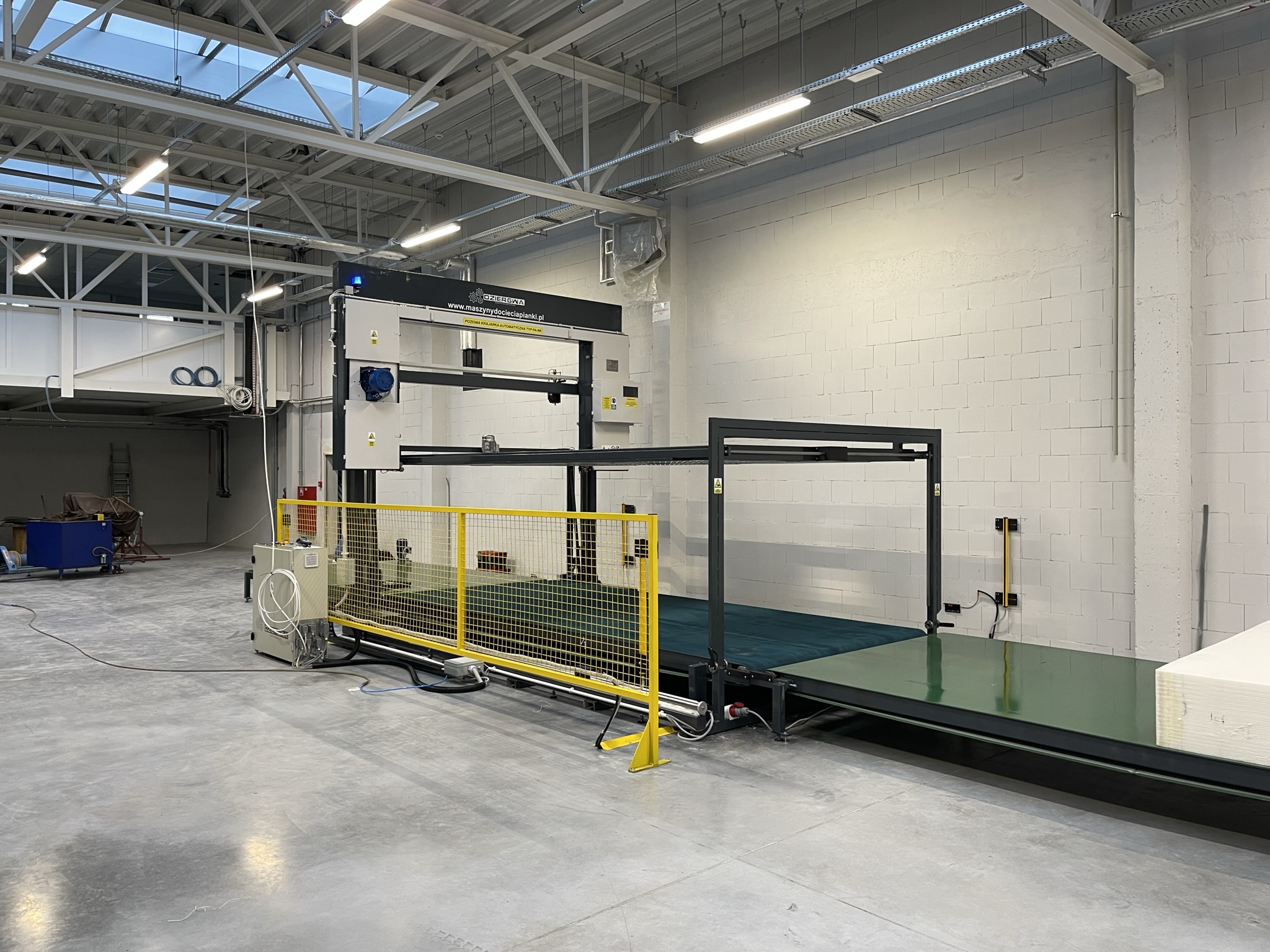
TL;DR: PUR (polyurethane) foam and PIR (polyisocyanurate) foam differ primarily in their chemical structure, temperature and fire resistance. PIR has a higher isocyanurate index, which gives it better insulation and fire resistance. Both foams are cut mechanically with band knives or strings - the choice of machine depends on the density of the material.
What is PUR (polyurethane) foam?
Polyurethane foam (PUR) is produced by reacting polyol with isocyanate. We distinguish:
- Flexible PUR (density 15–80 kg/m³) - furniture, mattresses, automotive
- Semi-rigid PUR (35–100 kg/m³) - technical insulation, packaging
- Rigid PUR (30–200 kg/m³) - construction insulation, sandwich panels
PUR foam is the dominant material in the European upholstery industry - easy to process, available in a wide range of densities and hardnesses.
What is PIR (polyisocyanurate) foam?
PIR foam is an advanced version of PUR foam with a higher isocyanate to polyol ratio (>2:1). Key Features:
- Better temperature resistance (up to 180°C vs 100°C for PUR)
- Higher fire resistance - forms a charred skeleton instead of melting
- Better thermal insulation: λ = 0.022–0.026 W/(mK)
- Higher density: usually 30–50 kg/m³
PIR is mainly used in construction: sandwich panels, flat roofs, cold stores, facade cladding.
PUR vs PIR – key differences
Application temperature:
- PUR flexible: up to 100°C
- PIR rigid: up to 180°C
Fire resistance (according to EN 13501):
- PUR: class E–D
- PIR: class C–B
Lambda (insulation):
- PUR stiff: λ = 0.025–0.040 W/(mK)
- PIR: λ = 0.022–0.026 W/(mK)
Typical densities:
- PUR flexible: 15–80 kg/m³
- PIR stiff: 30–50 kg/m³
Price:
- PIR is 20-40% more expensive than comparable rigid PUR
How to cut PUR and PIR foam?
Flexible PUR foam (furniture, mattresses) - cut with a band knife in a vertical PPA or horizontal PARK cutter. Precision ±1–2 mm, cutting speed up to 10 m/min.
Rigid PUR and PIR foam - cutting with a band knife in a vertical or horizontal cutter with increased drive power. Hard foams require reinforced guides and more powerful motors.
PIR foam in sandwich panels - cutting with a circular saw or band knife with a dust extraction system. DZIERGWA produces machines dedicated to cutting ready-made PIR/PUR panels in prefabrication lines.
Applications of PUR and PIR foam
PUR foam - applications:
- Upholstery: inserts for sofas, armchairs, mattresses
- Automotive: seats, door linings, insulation
- Packaging: protective inserts for precision devices
- Medicine: anti-decubitus mattresses, orthoses
PIR foam - applications:
- Construction: flat roof, sandwich walls, facades
- Refrigeration: cold rooms, industrial cold stores
- Industry: insulation of industrial installations
How does DZIERGWA choose a machine for PUR/PIR foam?
Our engineers analyze: foam density, required cutting dimensions, tolerances, production scale and output format. Based on this, we recommend the optimal machine - or design it from scratch to meet the customer's requirements. Since 1997, 800+ machines in 19 countries, including dedicated PIR lines for the largest sandwich panel manufacturers in Europe.
Frequently asked questions (FAQ)
Can the same machine cut both PUR and PIR?
Yes, while maintaining the appropriate excess power and appropriate knife parameters. PIR foam is harder and more abrasive - we recommend machines with reinforced guides.
Does PIR cutting generate hazardous fumes?
Mechanical PIR cutting with a band knife generates dust that requires extraction. It does not generate chemical fumes, unlike thermal cutting. All DZIERGWA machines can be equipped with dust extraction systems.
Contact us — we'll be happy to advise and prepare an offer tailored to your needs!