
TL;DR: Three common foam types cut differently. HR foam (35–50 kg/m³) is resilient and cuts fast with a band knife. Viscoelastic (memory) foam (50–85 kg/m³) is slow-recovery and tacky — it needs a very sharp blade, slower feed and blade cooling. Cold-cure foam (molded HR) can be non-uniform and needs an allowance for internal stress. Matching blade and feed speed to the specific foam determines edge quality.
How to cut HR (high-resilience) foam?
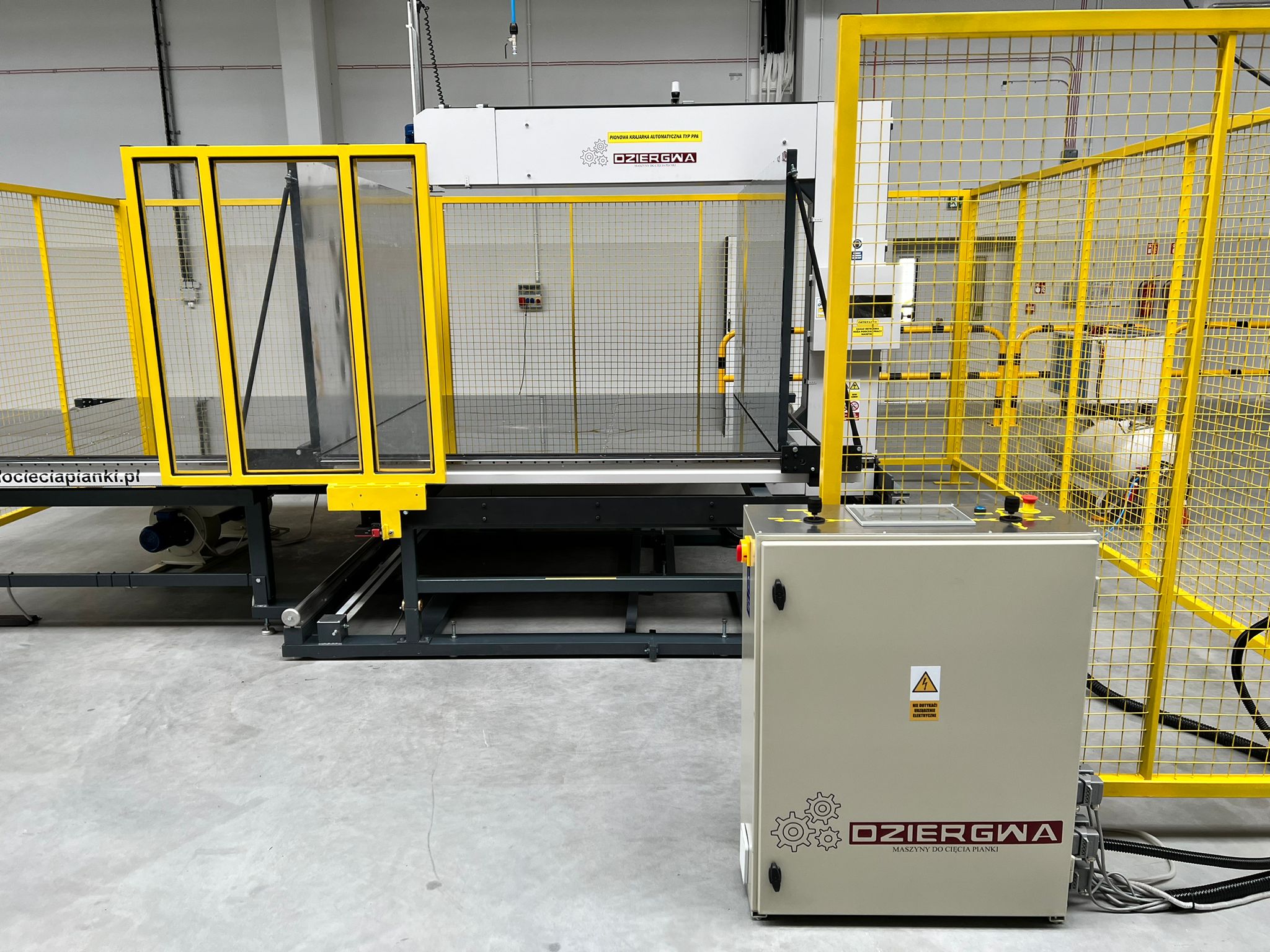
HR foam of 35–50 kg/m³ is cut with a band knife at full speed — its resilience and uniform cell structure give a smooth, straight edge. It is the easiest material to process, used in upholstered furniture and mattresses. DZIERGWA horizontal and vertical cutters (PARK, PPA) handle it without adjustments: standard blade, standard feed. The only condition is a sharp blade — denser HR wears it faster.
How to cut viscoelastic (memory) foam?
Viscoelastic foam is tacky and recovers slowly, so it needs a very sharp blade, reduced feed and often blade cooling. At 50–85 kg/m³ the material "drags" behind the blade and, at too-high speed, the edge becomes ragged. Rules for cutting memory foam:
- use a freshly sharpened, thin blade,
- reduce feed speed by 20–40% compared with HR,
- keep the foam at room temperature (cold memory foam hardens and cuts worse),
- consider cooling or coating the blade to reduce sticking.
How to cut cold-cure foam?
Cold-cure (molded HR) foam is cut with a dimensional allowance, because molded parts have a skin and internal stresses that slightly change the size once cut. The material can be non-uniform — harder at the skin, softer in the core — so the blade should be sharp and the feed even. Resting the parts before cutting lets the stresses stabilize.
Cutting parameters by foam type
- HR (high-resilience) — Density: 35–50 kg/m³; Blade: standard; Feed: full; Note: easiest
- Viscoelastic (memory) — Density: 50–85 kg/m³; Blade: very sharp, thin; Feed: reduced; Note: tacky, cool the blade
- Cold-cure (molded) — Density: 40–60 kg/m³; Blade: sharp; Feed: even; Note: allow for stress
FAQ
Why does memory foam cut worse than HR? Because it is viscoelastic — it deforms slowly and sticks to the blade. A slower feed and a sharp, cooled blade solve the ragged-edge problem.
Does foam temperature matter for cutting? Yes, especially for memory foam. Cold viscoelastic foam hardens and cuts unevenly; the optimal cutting temperature is 18–24°C.
Which foam density is easiest to cut? HR foam of 35–50 kg/m³ is the easiest — it is resilient, uniform and does not stick to the blade.
Cutting several foam types? We will match the machine and parameters to your material — see the DZIERGWA automatic machines or write to us.
Contact us — we'll be happy to advise and prepare an offer tailored to your needs!