
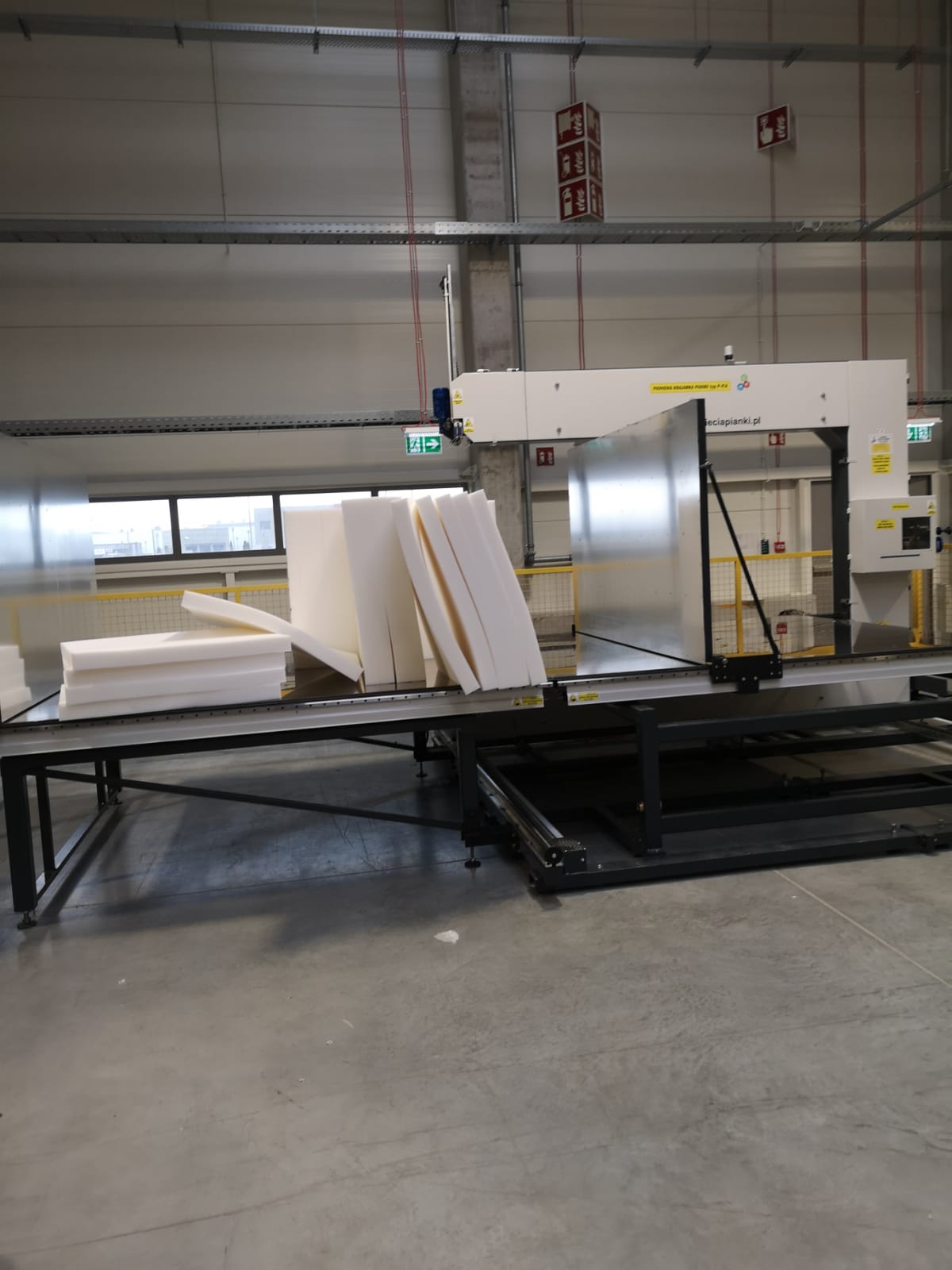
TL;DR: An automatic foam cutting machine (PPA) with a CNC controller cuts the block in auto mode and is profitable for large volumes and multi-shift work, because it reduces labor costs and waste. The PPRK semi-automatic machine is cheaper to purchase and is sufficient for small, single-shift series, where the operator sets subsequent cuts manually. The choice comes down to three numbers: production volume, number of shifts and investment budget.
Automatic or semi-automatic machine - the shortest answer
The decision between automatic and semi-automatic is not a matter of which device is "better", but which one fits your production profile. The automatic foam cutting machine takes over the entire process - the CNC controller positions the block, selects the thickness of the slice and performs the cutting sequence without operator intervention. Semi-automatic PPRK supports the operator (drive, pressure, knife guidance), but it is the human who sets subsequent positions and decides on the rhythm of work.
In the DZIERGWA offer, the automatic machine is represented by the PPA series (vertical cutting machine, cutting 7–1000+ mm, touch panel, up to 10 thicknesses from one block), and the semi-automatic machine is PPRK. Full characteristics of the automatic solution can be found in the article about automatic foam cutting machine.
What is the difference between an automatic machine and a semi-automatic machine
The key difference lies in the degree of automation of the cutting cycle:
- Automatic (PPA) - the operator enters the program on the touch panel, the machine runs it independently in auto mode, from the first to the last slice. CNC control, pneumatic knife tension, repeatability ±1–2 mm.
- Semi-automatic (PPRK) - the machine supports cutting mechanically and pneumatically, but the positioning of subsequent slices is performed by the operator**. There is no complete program sequence; the pace depends on the person.
In practice, the machine "remembers" the entire plan for cutting a block, and in a semi-automatic machine, this plan is kept in the operator's head and recreates it manually with each slice. This translates into differences in performance, costs and maintenance requirements.
Cost - purchase vs operating cost
When comparing cost, you need to separate two levels.
Purchase cost
The PPRK semi-automatic has a lower purchase price than the PPA automatic - simpler control design means a lower barrier to entry. For a small plant that is just starting out or makes small series, this is often a decisive argument.
Unit cost of production
In the long run, however, what matters is the cost of cutting one slice, and here the machine has the advantage:
- lower labor cost - one operator supervises the machine instead of making every cut,
- less raw material waste - CNC precision reduces cutting, and foam is an important cost item,
- fewer supplies and complaints thanks to repeatability of ±1-2 mm.
Therefore, with increasing volume, a cheaper semi-automatic machine tends to be more expensive per unit of production. A broader approach to investment costs is described in the text how much does a foam cutting machine cost.
Performance - where the automatic wins and where the semi-automatic is enough
An automatic foam cutting machine increases efficiency on three levels: shortens cycle time (no gaps between slices), reduces staffing (one operator instead of several) and improves raw material utilization. This is most visible in multi-shift work and repetitive series - the machine maintains a constant pace throughout the entire shift.
The PPRK semi-automatic machine is flexible for short, variable series and single orders, where the programming of the machine will not be amortized in time. If a plant cuts several blocks a day in various configurations, the simplicity of a semi-automatic machine can be an advantage.
| Criterion | PPA machine | Semi-automatic PPRK |
|---|---|---|
| Working mode | auto (CNC, up to 10 thicknesses/block) | manual positioning |
| Performance | high, constant pace | dependent on operator |
| Purchase cost | higher | lower |
| Best at | large volumes, multi-shift | small, variable series |
Operation - operator and training
In the machine, the operator's role shifts from cutting to supervision and program management. The touch panel shortens the training, and the auto mode often allows you to operate another station in parallel. The risk of human error is lower because the machine monitors the thickness and sequence.
The semi-automatic machine requires continuous attention of the operator - he is responsible for repeatability, so the quality depends on his skill. This is a significant risk in the case of variable staffing or employee turnover. How to choose a device for your team and production profile is provided in the guide how to choose a foam cutting machine.
When to choose an automatic and when a semi-automatic
Choose automatic foam cutting machine (PPA) when:
- you work two or three shifts,
- you produce repeatable series (mattresses, inserts for sofas and armchairs, upholstery elements),
- you want to minimize waste and labor costs,
- you need constant repeatability of ±1–2 mm.
Choose semi-automatic PPRK when:
- you cut small, single-shift series or single orders,
- you have a limited investment budget,
- Your production is very variable and cannot be easily programmed.
You will find semi-automatic machines in manual machines category, and vertical machines in automatic machines category. If you are also considering cutting orientation (vertical vs. horizontal), the text [automatic vertical or horizontal] will be helpful(/en/wiedza/automat-pionowy-czy-poziomy).
Summary
An automatic foam cutting machine is profitable where volume, repeatability and low unit cost are important - i.e. in multi-shift and serial production. The PPRK semi-automatic machine is a reasonable choice for small, variable batches and a limited budget. The break-even point is three numbers: volume, number of changes and purchase price.
You don't know what to choose? Contact us - we will help you compare the PPA machine and the PPRK semi-automatic machine in terms of your production and estimate the return on investment. Go to contact or see the full automatic machines offer.
Contact us — we'll be happy to advise and prepare an offer tailored to your needs!