
TL;DR: To choose a good foam cutting machine, start by asking what and in what quantity you produce, and then go through 9 criteria: cutting type (vertical, horizontal, contour, hybrid), maximum block size, thickness range, precision (±1-2 mm), efficiency, degree of automation, software (devFOAM 2, DXF/SVG import), service and total cost of ownership. This buying guide takes you through each of these points step by step so that you don't overpay and buy a machine that won't keep up with production.
Where to start when choosing a foam cutting machine
Before you compare specific models, answer three business questions: what do you cut (mattresses, sofa inserts, shaped pillows, packaging, acoustic panels, mineral wool), how many pieces per day do you have to produce and how will it change in 2-3 years. The most common mistake when purchasing is selecting a machine for today's production, without any capacity for development.
A well-chosen foam cutting machine means not only lower cost per piece, but also less waste, repeatable quality and shorter changeover time. If you're just starting out and want to learn about the types of equipment, start with foam cutting machine guide. Below we focus solely on the purchase decision.
Criterion 1: cut type (vertical, horizontal, contour, hybrid)
This is the most important decision because it determines everything else. Match the machine type to the product:
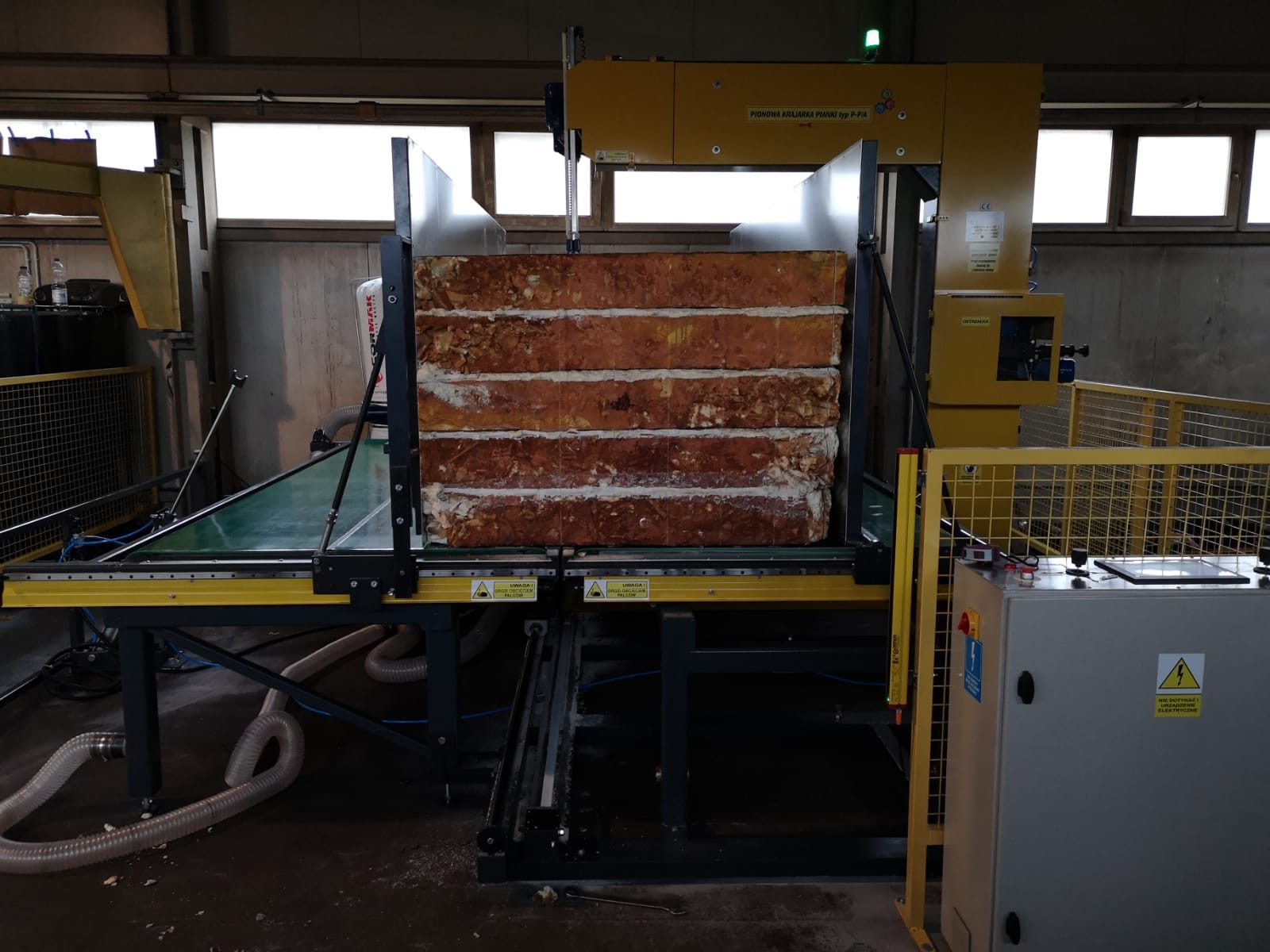
- slices of a given thickness from a block → vertical PPA cutter,
- thin sheets and panels in continuous production → horizontal PARK, PPAB cutter,
- 2D/3D shapes, pillows, profiled packaging → CNC contour machine (KPO, KPA),
- flexibility: sheets and contours in one machine → hybrid HPA, KPAH design.
If you are hesitating between two basic designs, the text vertical or horizontal machine will be helpful.
Criterion 2: maximum block size and thickness range
Make sure the machine will accommodate the largest block you are processing and the full range of cutting thicknesses. The PPA vertical machine cuts slices from 7 to over 1000 mm and allows you to obtain up to 10 different thicknesses from one block in automatic mode. Horizontal machines specialize in thin sheets of repeatable thickness. Too small a working size means additional preliminary cuts and loss of material, so this parameter should be oversized.
Criterion 3: precision and edge quality
The standard for DZIRGWA machines is precision of ±1–2 mm. In practice, the quality of the edges is also determined by construction details:
- pneumatic knife tension - even, perpendicular edge without waving,
- linear guides and pneumatic pressure - stable material guidance,
- type of tool for contour cutting - oscillating knife for denser foams, heating wire (hot wire, 200-400°C) for smooth surfaces and light foams.
The higher the repeatability required (e.g. export, automotive, orthopedics), the more important these elements are.
Criterion 4: performance and operating mode
Estimate the real daily efficiency and compare it with the machine's capabilities. Continuous production (belt conveyor in horizontal machines) will work well for large series of mattresses and sofa inserts. For smaller, varied orders, the speed of changeover and the memory of cutting programs are important. Remember that CNC automatic mode limits operator involvement and maintains a constant pace regardless of operator fatigue.
Criterion 5: degree of automation (automatic, semi-automatic, manual)
This criterion strongly influences the price and turnaround time. You can choose from:
- CNC machines - the highest repeatability and efficiency, the smallest operator involvement,
- semi-automatic PPRK - cheaper entry into foam cutting while retaining some of the automation,
- manual machines - lowest cost, for small series and prototypes.
The decision will be made easier by comparing automatic machines with manual machines and the article automatic or semi-automatic machine.
Criterion 6: software and controls
When it comes to contour cutting, software is key. KPO/KPA machines work in devFOAM 2 with import of DXF/SVG files, which allows you to quickly transfer the design from CAD to the machine and repeat it without error. Pay attention to the touch panel, program memory and ease of use by the operator - the intuitive interface shortens implementation and reduces mistakes. You can read more about what automation offers in the text about CNC contour machine.
Criterion 7: type of material being cut (foam or mineral wool)
Mineral wool requires a different construction than polyurethane foam. Machines dedicated to wool take into account dustiness and abrasion - they are equipped with hard blades and extraction. If you process both materials, please indicate this at the inquiry stage, as it determines the selection of tools and equipment. Details can be found in the article about mineral wool cutting machine.
Criterion 8: waste management and complementary facilities
A well-planned line is not only about the cutter itself. Foam scraps take up a lot of space and generate disposal and transport costs - this is solved by a foam waste press, which briquettes and compresses the waste. In turn, the pillow stuffer automates filling pillowcases with shredded foam or silicone balls. An overview of such devices can be found in the [other devices] section(/en/oferta/inne-urzadzenia).
Criterion 9: service, warranty and total cost of ownership
Finally, calculate the total cost of ownership (TCO), not just the purchase price. What counts are: parts availability, service response time, energy consumption, cost of tools (knives, strings) and potential savings on waste. The Polish manufacturer shortens the service route and facilitates technical communication. If budget is a starting point, check out the article how much does a foam cutting machine cost.
Summary - How to choose a foam cutting machine without making mistakes
The choice comes down to matching the cutting type to the product, and then verifying the block size, precision, efficiency, automation, software, material, waste management and cost of ownership. Going through these 9 criteria protects you from overpaying and purchasing a machine that will not keep up with production. DZIERGWA, as a Polish manufacturer of foam cutting machines, helps you select the configuration for a specific plant - from a single cutter to the entire line. Do you want to choose a machine for your production? Contact us and we will prepare an offer tailored to your needs.
Contact us — we'll be happy to advise and prepare an offer tailored to your needs!