
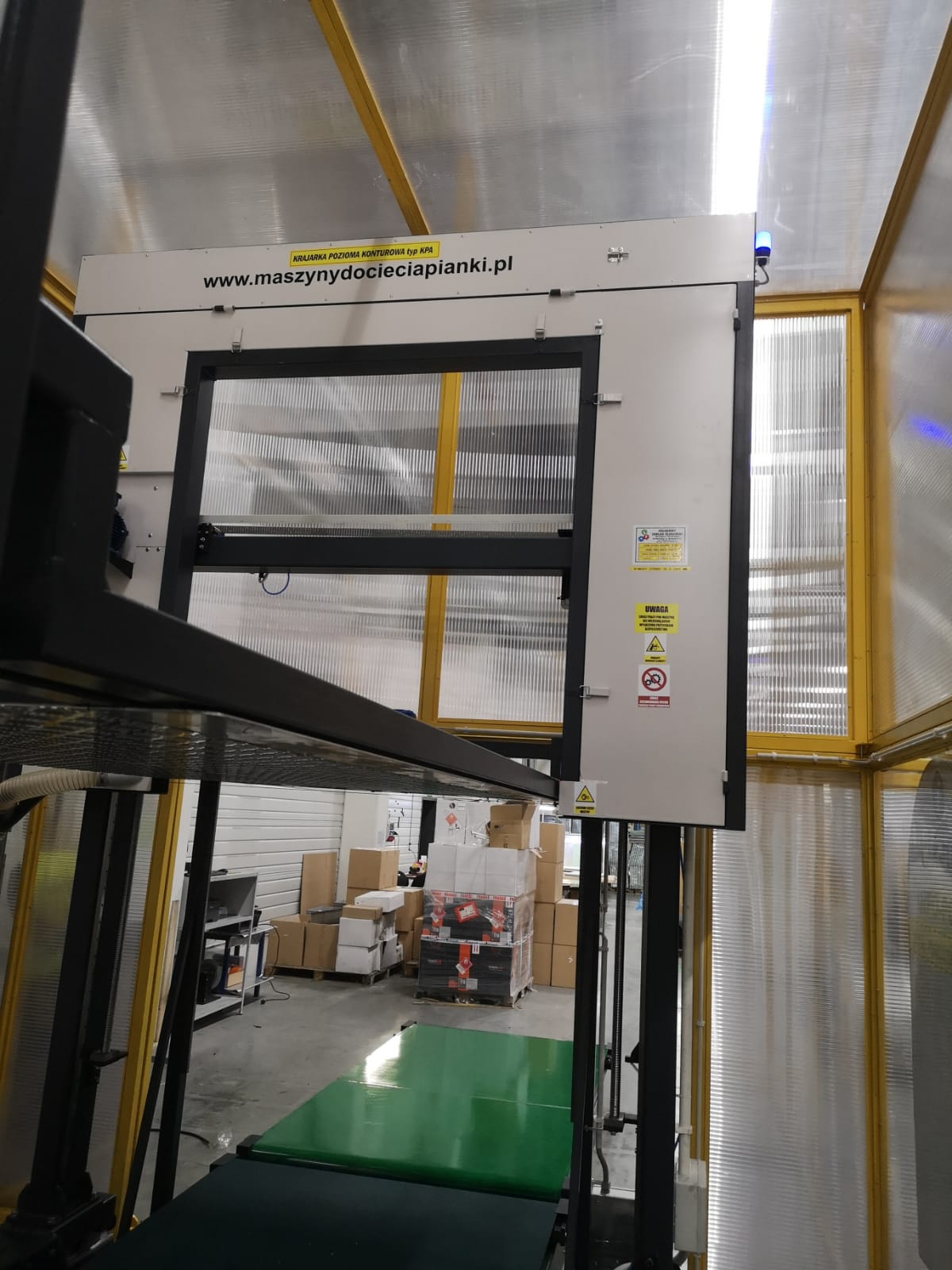
TL;DR: A contour machine is a CNC machine that cuts any 2D and 3D shapes from foam - with an oscillating knife or a heating wire, based on a program uploaded from DXF/SVG files. In the DZIERGWA offer, the KPO type is responsible for this, controlled by the devFOAM 2 software. This is a solution for the production of profiled pillows, shaped packaging, suitcase inserts, acoustic panels and elements for the automotive and orthopedic industries.
What is a CNC contour machine
Contour machine is a numerically controlled machine that, instead of simple cuts into slices (like a vertical or horizontal cutter), cuts complex contours and profiles from a block or sheet of foam. The cutting tool - an oscillating knife or a heated string - moves along a path described by the CNC program, thanks to which the machine reproduces the shape with an accuracy of single millimeters.
Unlike straight cutting, where the thickness of the slice is mainly important, in contour cutting the key factor is the geometry of the tool path**. The operator does not set a single dimension, but uploads a ready-made technical drawing, and the controller converts it into axis movement. This makes the contour machine the most universal machine in the park for processing foam.
In the DZIERGWA portfolio, this role is played by the KPO model - a CNC cutting machine/contour machine. You will find the machine in the [automatic machines] category(/en/oferta/maszyny-automatyczne), next to vertical and horizontal machines.
2D and 3D cutting - what is the difference
The contour machine has two operating modes, which are worth distinguishing when selecting the machine.
2D cutting
In the 2D mode, the tool cuts vertically through the entire height of the material, reproducing the contour drawn on the plane. This is how, for example, seals, foam inserts for tool cases (so-called inlay), letters, logos and shaped packaging are created. This is the most common application and the fastest form of work.
3D cutting
In 3D mode, the machine additionally controls the angle and depth of the tool, creating inclined surfaces, chamfers, wavy profiles and solids with variable cross-sections. Profiled pillows, orthopedic mattresses, car seat elements and acoustic panels with a pyramid structure work well here. 3D cutting requires precise programming, but produces effects that are impossible to achieve manually.
We have described more practical examples in the article about applications of contour cutting of foam.
Oscillating knife or string - choosing a tool
The KPO contour machine can operate with two cutting technologies, and the choice depends on the material and the expected edge quality.
- Oscillating knife - the vibrating blade cuts mechanically. It is suitable for foams with higher density and hardness, composite materials and where sharp, perpendicular edges and deep cuts are needed.
- Hot wire - a heated wire (usually in the range of ~200-400°C) melts the foam, giving a very smooth surface without crumbs. Perfect for light foams, 3D shapes and aesthetic contours.
If you are only interested in string technology, DZIERGWA also offers a dedicated string cutter KPA. For plants combining horizontal and contour cutting, hybrid machines (HPA, KPAH) are available. The principle of operation of the control is described in the entry about CNC control in cutting machines.
devFOAM 2 software and DXF/SVG import
The heart of every contour machine is the software. KPO machines are controlled by the devFOAM 2 program, which converts a vector drawing into a tool path.
Key Features:
- Import of DXF and SVG files - you can load a design prepared in CAD or a graphics program directly, without manually redrawing the outline.
- Path editing and optimization - cutting order, entry points, tool width compensation.
- Simulation and preview - check the flow before starting, which reduces material waste.
- Nesting of shapes - maximum use of the surface of a block or sheet.
Thanks to the support of DXF/SVG formats, changing from one pattern to another is a matter of loading a file and not tedious mechanical adjustment. This reduces response time to non-standard orders and facilitates the production of short series.
Applications of contour machine
The CNC contour machine is used wherever the foam must take a repeatable, unusual shape:
- Cushions and profiled inserts - furniture, automotive, armchairs.
- Shaped packaging - foam moldings protecting electronics, tools, medical equipment.
- Inlay for suitcases and chests - sockets adapted to specific tools.
- Acoustic panels - pyramid and corrugated profiles for studios and halls.
- Orthopedics and rehabilitation - shapes, supports, inserts.
- Letters, logos, decorative and exhibition elements.
In the process line, the machine cooperates with automatic machines for cutting blocks into slices and with a foam waste press, which compresses the resulting scraps and reduces disposal costs.
Parameters and precision
The effect of the contour machine's operation is determined by:
- Cutting precision - in KNITTING machines of ±1–2 mm, thanks to CNC control and linear guides.
- Tool type - oscillating knife or string, selected according to the material.
- Working area - selected to the format of the processed blocks/sheets.
- Control - touch panel and devFOAM 2 with DXF/SVG import.
- Repeatability - crucial for series, guaranteed by the program instead of manual adjustment.
It is worth consulting the selection of a specific configuration in terms of the type of foam and typical orders. If you are not sure whether you need a contour machine or a slicing machine, the guide how to choose a foam cutting machine will be helpful.
Summary and contact
The KPO type CNC contour machine is the most flexible tool in a foam processing plant - it cuts 2D and 3D shapes with an oscillating knife or string, and programming via devFOAM 2 with DXF/SVG import makes the transition between patterns immediate. This is an investment that opens the production of non-standard and short series products.
Do you want to choose a contour machine for your production? DZIERGWA is a Polish manufacturer of foam cutting machines - contact us and we will help you choose the KPO configuration for your materials and products.
Contact us — we'll be happy to advise and prepare an offer tailored to your needs!